






A New Era: The Artemis Program
The ambition for a permanent lunar settlement is being driven by NASA's Artemis program. This international endeavour aims to establish a sustainable human foothold on the Moon, specifically near the resource-rich South Pole. The plan, often referred
to as the Artemis Base Camp, represents a monumental shift in philosophy. Instead of short, Apollo-style sorties, the focus is on creating the infrastructure for long-duration stays, scientific research, and testing technologies for future missions to Mars. The program involves a series of increasingly complex missions, beginning with robotic cargo deliveries and culminating in a habitat that can support astronauts for up to two months at a time. This isn't just about exploration; it's about learning to live and work in a completely alien environment.
Gateway: An Outpost in Lunar Orbit
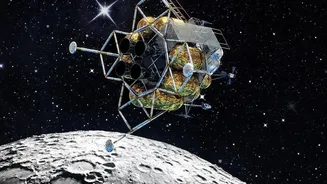
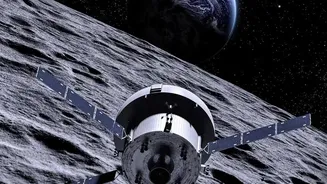
Before setting up a permanent home on the surface, NASA and its international partners, including the European, Japanese, and Canadian space agencies, are building a small space station in lunar orbit called the Gateway. Think of it as a staging post or a deep-space harbour. It will serve as a rendezvous point for astronauts travelling from Earth in the Orion spacecraft. From the Gateway, crews can then board specialized landers for their trip down to the lunar surface. This orbital platform provides a crucial link in the logistics chain, supporting longer and more complex surface missions than would be possible by travelling directly from Earth each time. It will also function as a science laboratory and a hub for testing deep-space technologies.
Artemis Base Camp: A Home on the Moon
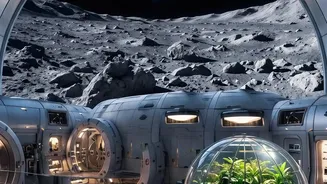
The heart of the plan is the Artemis Base Camp itself. This surface outpost will consist of several key elements. The initial habitat will be a foundational surface structure, envisioned as a modern cabin that can house four astronauts. For mobility, astronauts will use an unpressurized Lunar Terrain Vehicle (LTV) for short trips, similar to a lunar dune buggy. For longer expeditions, a larger, pressurized rover will act as a mobile home, allowing crews to travel for days across the rugged terrain in a comfortable, shirt-sleeve environment. This combination of a fixed habitat and robust rovers will allow astronauts to conduct extensive scientific research across the lunar South Pole region.
Living off the Land
The key to making a moon base 'enduring' is sustainability, and that means using local resources. This concept, known as In-Situ Resource Utilization (ISRU), is central to the Artemis plan. The lunar South Pole was chosen specifically because its permanently shadowed craters are believed to contain vast deposits of water ice. This ice can be mined and processed to produce breathable air for astronauts and, critically, hydrogen and oxygen for rocket propellant. Being able to refuel on the Moon would revolutionize space travel, making the base a true stepping stone to Mars and beyond. Other ISRU plans involve using lunar soil, or regolith, as a construction material, potentially for 3D-printing habitat components and radiation shielding.
The Immense Challenges Ahead
Building and operating a moon base is an undertaking of immense difficulty. The lunar environment is unrelentingly hostile. With virtually no atmosphere, there is no protection from intense solar radiation and micrometeorite impacts. The temperature swings are brutal, cycling between scorching heat and cryogenic cold. Perhaps the biggest menace is the lunar dust, or regolith. This fine, abrasive powder is electrostatically charged, clinging to everything and posing a severe threat to both equipment and astronaut health. It can wear down seals, clog mechanisms, and, if inhaled, cause serious lung damage. Furthermore, ensuring a reliable power supply through the long, dark lunar night requires robust energy generation and storage solutions, likely a combination of solar arrays and nuclear fission power systems.