




As comforting aromas fill the air, two favourites often take centre stage: sweet potatoes and chestnuts. Many wonder which is healthier, but the real secret to enjoying them isn't picking a side, but understanding the power of a single portion.
A Tale of Two Favourites
Sweet potatoes,
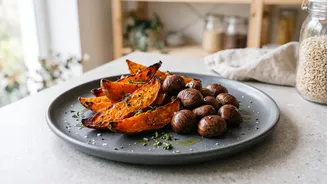
or 'shakarkandi', are a beloved root vegetable, celebrated for their creamy texture and sweet flavour, often enjoyed roasted by street vendors or in vibrant chaats. Chestnuts, on the other hand, are technically a fruit from the Castanea tree. Unlike other nuts, they are relatively low in fat and high in starch, giving them a soft, floury texture when cooked, closer to a potato than an almond. This unique composition makes their nutritional profile surprisingly comparable to starchy vegetables, setting the stage for a fascinating comparison. While both are seasonal staples, their nutritional gifts are distinct, and how we consume them makes all the difference.
The Nutritional Breakdown
Let's look at 100 grams of each, roasted. Roasted chestnuts contain around 245 calories, 53g of carbohydrates, and about 5g of fibre. They are also a fantastic source of Vitamin C, B vitamins, and minerals like copper and manganese. In contrast, 100 grams of a baked sweet potato has about 90 calories, 20g of carbohydrates, and 3g of fibre. Its claim to fame is its incredible Vitamin A content, providing more than double the daily requirement in a single serving, which is vital for vision and immune health. So, gram for gram, sweet potatoes are lower in calories and carbs, while chestnuts offer more fibre and a different set of vitamins.
Why Portion Is Paramount
Here's where the 'no winner' clause of the headline comes into play. The nutritional data is only useful when applied to a realistic serving. A standard portion of sweet potato is considered about half a medium-sized tuber, while a serving of chestnuts is roughly a handful of five or six nuts. It’s easy to eat two or three handfuls of roasted chestnuts while chatting with friends, which can quickly add up to more calories and carbohydrates than a single, satisfying sweet potato. Overconsumption of either can lead to gastrointestinal discomfort or bloating, as both are high in fibre and carbs. The lesson is clear: a small portion of a calorie-dense food can easily fit into a healthy diet, while a large portion of a 'healthier' food can throw your goals off track. Moderation isn't just a suggestion; it's the most important factor.
The Glycemic Question
For those managing blood sugar, the glycemic index (GI)—a measure of how quickly a food raises blood glucose—is crucial. Here again, preparation is key. Chestnuts generally have a low GI. Sweet potatoes are more variable. Boiled sweet potatoes have a low-to-medium GI, as the starch structure holds up better. However, roasting or baking a sweet potato can raise its GI significantly, making it comparable to white potatoes because the process breaks down the starches into more readily available sugars. So, a boiled sweet potato may have a gentler impact on blood sugar than a large portion of roasted chestnuts, but a baked sweet potato might cause a sharper spike. This shows that it's not just what you eat, but how you cook it.
Beyond the Numbers: In The Kitchen
Both ingredients are wonderfully versatile. Sweet potatoes can be baked, boiled, mashed into savoury dishes, or used as a base for healthier desserts. Their natural sweetness and creamy texture make them a comforting addition to almost any meal. Chestnuts are equally adaptable. They can be roasted for a simple snack, pureed into soups, or ground into flour for glutenfree baking. Their subtly sweet,, nutty flavour pairs well with both savoury and sweet dishes. The best choice often comes down to the role you want the ingredient to play. Are you looking for a starchy base for a meal,, or a nutrientdense snack to tide you over? Both can fill these roles,, just in slightly different ways.