



The Cosmic Cartographers
At the forefront of this revolution is the European Space Agency’s Gaia mission. Think of it as the grandest census ever conducted, not of people, but of stars. Launched in 2013, this space observatory has been meticulously charting a three-dimensional
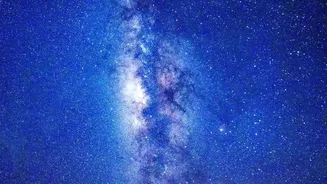
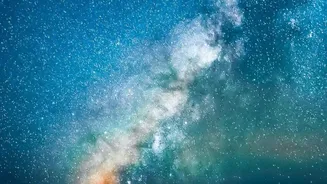
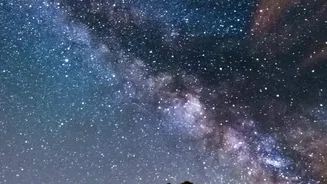
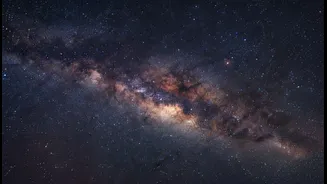
map of our Milky Way galaxy. The numbers are staggering: Gaia has tracked the positions, movements, and brightness of nearly two billion stars. This isn't just a static map; it's a dynamic movie of our galaxy, capturing the intricate dance of celestial bodies over cosmic timescales. By repeatedly observing each star, Gaia provides an unprecedented dataset that allows astronomers to trace our galaxy's structure and evolution over billions of years.
How to Read a Star
But how do we extract a star’s life story from a single point of light? The secret is in the light itself. By using a technique called spectroscopy, astronomers can split starlight into its constituent colours, like a cosmic rainbow. This spectrum is riddled with dark lines, which act as a chemical fingerprint, revealing the elements present in the star's atmosphere. Generally, older stars that formed early in the universe's history are made of more basic elements like hydrogen and helium. Younger stars, born from the recycled ashes of previous generations, are richer in heavier elements, which astronomers collectively call “metals”. Beyond chemistry, astronomers determine age using several clever methods. One classic tool is the Hertzsprung-Russell diagram, which plots a star’s brightness against its temperature to identify its current life stage. More advanced techniques include 'gyrochronology', which estimates age based on how fast a star spins (older stars tend to spin slower), and 'asteroseismology', which studies the star’s vibrations or 'starquakes' to understand its internal structure and age.
A Galactic Family Tree
This new field of study is often called 'galactic archaeology'. Much like archaeologists on Earth dig for fossils to understand the past, astronomers use stars as cosmic fossils to piece together the history of the Milky Way. Stars are typically born in large groups or clusters from the same giant cloud of gas and dust. This means every star born in a particular cluster has the same unique chemical signature. Over billions of years, the galaxy's gravitational forces pull these clusters apart, scattering the sibling stars across the sky. By identifying stars with a shared chemical 'DNA', astronomers can trace them back to their common origin. This allows them to reconstruct ancient star-forming events and even identify streams of stars that are the remnants of smaller galaxies the Milky Way consumed in its past, slowly building the grand structure we see today.
Mapping the Milky Way's Shape
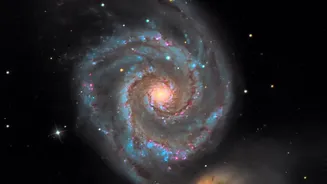
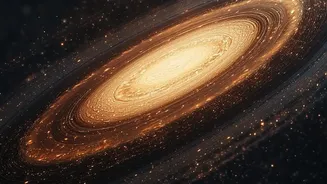
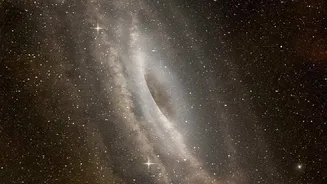
Beyond individual star stories, this colossal amount of data allows us to map the overall structure and density of our galaxy with stunning precision. By plotting the locations of millions of stars, we can clearly see the different components of the Milky Way, such as the flat, sprawling disc where our Sun resides, the dense central 'bulge', and the vast, spherical 'halo' surrounding it all. For instance, by focusing on very hot, bright, and short-lived stars known as OB stars, astronomers can pinpoint active regions of star formation, effectively tracing the beautiful spiral arms of our galaxy. These density maps are no longer just artist's impressions; they are detailed architectural blueprints of our galactic home, built from real data.