



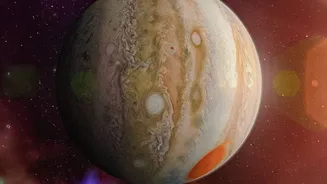
As summer's haze gives way to the crisp, clear nights of autumn, a remarkable celestial opportunity comes into view. High in the sky, the giant planet Jupiter puts on a show, and you don't need a fancy telescope to see its most famous moons.
The Autumn Advantage for Stargazers
There’s a
reason why the night sky often seems sharper and more brilliant in autumn. As the season changes, the atmosphere itself becomes more favorable for stargazing. The humid, hazy air of summer is often replaced by cooler, drier air masses. This reduction in atmospheric moisture and particles means there is less haze to scatter city lights and blur the cosmos. The result is better 'transparency,' allowing the light from distant stars and planets to travel to your eyes with less distortion. Additionally, darkness simply arrives earlier. As the sun sets sooner each evening in September and October, you no longer have to stay up past midnight to enjoy a truly dark sky, making it a more accessible and comfortable experience for casual observers and families. This combination of clearer air and longer nights makes autumn the prime season for looking up.
Jupiter Takes Centre Stage
While the autumn sky is full of wonders, Jupiter is a particularly brilliant jewel right now. Throughout late 2026, the gas giant is exceptionally well-placed for viewing. Though its 'opposition'—the point where Earth passes directly between it and the sun, making it appear at its biggest and brightest—occurred in January 2026, the planet remains a dominant, steady light in the night sky. Unlike stars, which twinkle, Jupiter shines with a constant, powerful glow, making it easy to distinguish. In September 2026, Jupiter is a brilliant object in the pre-dawn eastern sky, often pairing beautifully with the Moon. On September 8, a rare event called a lunar occultation occurs, where the Moon passes in front of Jupiter, a spectacle visible with binoculars or a small telescope for observers in the right locations. Its brightness and position make it an unmissable target.
Your Simple Guide to Spotting the Moons
You might think you need a powerful telescope for planetary observation, but Jupiter’s four largest moons are surprisingly accessible. They were first spotted by Galileo Galilei in 1610 with his rudimentary telescope, and a modern pair of binoculars is more than enough to repeat his historic discovery. Any standard pair of binoculars, like 7x50 or 10x50, will do the trick. The key is stability. Since holding binoculars perfectly still is difficult, the slight shake of your hands can make the tiny moons hard to resolve. To counter this, brace your elbows on a steady surface like a wall, a car roof, or a fence post. Even better, use a tripod with a binocular adapter. Once you have Jupiter in focus, it will appear as a small, bright disc. Look closely to either side of the planet for what appear to be tiny pinpricks of light, all arranged in a nearly straight line that runs through Jupiter. Those aren't background stars; they are the Galilean moons.
Meet the Galilean Moons
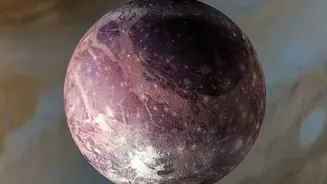
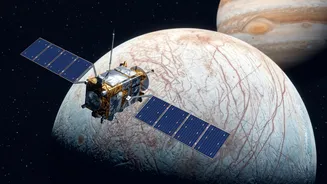
The four points of light you are seeing are worlds in their own right, each a unique and fascinating place. In order from Jupiter, they are Io, Europa, Ganymede, and Callisto. Io is the most volcanically active body in the entire solar system, its surface constantly reshaped by hundreds of volcanoes. Europa is covered by a shell of ice, beneath which scientists believe lies a vast saltwater ocean, making it a prime candidate in the search for extraterrestrial life. Ganymede is the largest moon in our solar system, even bigger than the planet Mercury. Finally, Callisto is a heavily cratered, ancient world that may also hide a subsurface ocean. As you watch them from night to night, you'll notice their positions change as they orbit the giant planet, sometimes disappearing as they pass behind or in front of it. This celestial dance is a direct, visible reminder of the dynamic nature of our solar system.