







What is the CAPSTONE Mission?
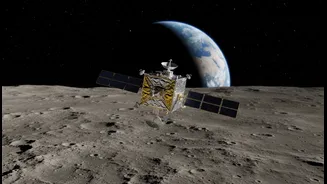
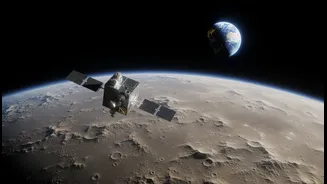
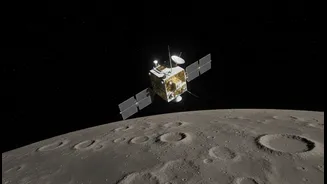
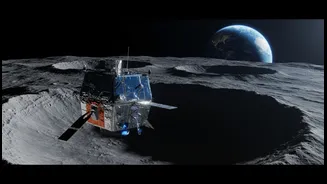
CAPSTONE is short for Cislunar Autonomous Positioning System Technology Operations and Navigation Experiment. Launched in June 2022, this 55-pound CubeSat's primary job was to be a pathfinder. Its main goal was to test a unique and highly efficient path around
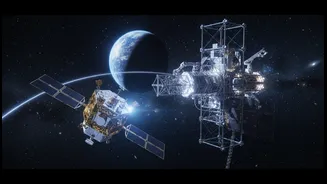
the Moon called a near-rectilinear halo orbit (NRHO). This specific orbit is crucial because it's the intended location for Gateway, a future space station that will serve as a staging point for missions to the lunar surface and beyond. By flying in this orbit first, CAPSTONE helped verify its stability and the propulsion needed to stay there, reducing risks for the far larger and more complex Gateway. Having completed its primary and extended mission objectives, NASA concluded its activities in June 2026, but the spacecraft continues to operate as a commercial testbed.
The Genius of Autonomous Navigation
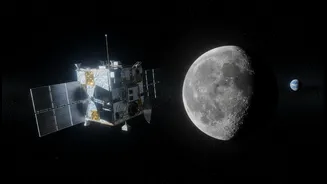
Perhaps the most groundbreaking part of the CAPSTONE mission is its test of an autonomous navigation system. Traditionally, spacecraft rely on constant communication with large antennas on Earth to know where they are. This is resource-intensive and creates a bottleneck as more missions head into deep space. CAPSTONE, however, demonstrated the Cislunar Autonomous Positioning System, or CAPS. This system allows spacecraft to determine their own position by communicating with other nearby spacecraft. CAPSTONE practiced this by exchanging signals with NASA's Lunar Reconnaissance Orbiter (LRO), which has been circling the Moon since 2009. By measuring the time it takes for signals to travel between them, the two spacecraft can calculate their relative positions, essentially creating a small-scale GPS system at the Moon.
Major Benefits for Future Exploration
The success of CAPSTONE's technologies offers significant advantages for the future of space exploration. First, autonomous navigation drastically reduces the reliance on Earth-based deep space networks. This frees up valuable antenna time for transmitting critical science data instead of routine tracking information. It also enables a more crowded and busy lunar environment, allowing multiple missions from different countries and companies to operate simultaneously without overwhelming ground control. The unique NRHO it validated is also a major benefit. It offers a stable position that requires minimal fuel to maintain, provides a constant line-of-sight to Earth for communications, and serves as an ideal staging area for landers heading to the lunar south pole.
Inherent Limits and Challenges
While groundbreaking, the CAPSTONE mission also highlights the challenges of pioneering new space technologies. As a small, relatively low-cost pathfinder, it was a high-risk mission by design. During its journey and operations, the spacecraft faced several anomalies, including issues with its communication system and a stuck thruster valve that caused it to tumble. The team successfully recovered the spacecraft, but these incidents underscore the unforgiving nature of deep space. Furthermore, the CAPS navigation system is still a demonstration. Its effectiveness depends on having other spacecraft to communicate with, meaning a robust network of satellites would be needed for it to become a fully independent navigation service. CAPSTONE proved the concept, but scaling it up for constant, reliable use across the entire Moon is a significant future step.