




A New Polygon in the Clouds
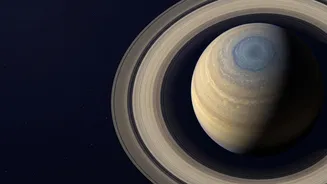
Astronomers using the Hubble Space Telescope have confirmed the existence of a massive atmospheric wave with ten distinct sides, forming a decagon around Saturn's south pole. This is the first time such a large, regular-sided jet pattern has been seen
in the planet's southern hemisphere. The structure appears to be a recent development, with archival Hubble data showing it began to emerge in 2023 and has become more defined since. This gives scientists a rare opportunity to watch a giant atmospheric pattern develop in real time. Unlike a solid object, the decagon is an atmospheric wave within a powerful jet stream, and observations show it is a towering structure that extends vertically through multiple layers of Saturn's atmosphere.
Saturn's Other Geometric Marvel
This new discovery immediately invites comparison to Saturn's most famous atmospheric feature: the persistent hexagonal storm at its north pole. First spotted by the Voyager mission in the 1980s, the northern hexagon is a six-sided jet stream that has remained remarkably stable for over 40 years. For decades, it was considered a unique oddity. The discovery of a southern decagon suggests that the conditions in Saturn's atmosphere may be conducive to forming these strange polygonal shapes at both poles. However, the two are not identical twins. The decagon has ten sides to the hexagon's six and is located at a different latitude, closer to the equator. Furthermore, the hexagon is a long-lived, stable feature, while the decagon appears to be a new and evolving phenomenon.
How Do Storms Form Straight Lines?
The question of how a turbulent, gaseous atmosphere can create stable geometric patterns has puzzled scientists for years. Research on the northern hexagon provides the leading theories. One hypothesis suggests that these shapes are the result of jet streams moving at different speeds at specific latitudes. Laboratory experiments have shown that when a circular tank of liquid is rotated at different speeds at its center and periphery, the turbulence at the boundary can organize itself into stable polygons. While a hexagon is a common result, these experiments have also produced shapes with three to eight sides. Another theory involves Rossby waves, which are giant meanders in high-altitude winds caused by a planet's rotation. These waves could be settling into a stable, resonant pattern that forms the vertices of the polygon. The discovery of a second, different polygon will provide crucial new data for testing these models.
The Mystery of a Moving, Growing Shape
Perhaps the most exciting aspect of the southern decagon is that it's active. Scientists have been searching for a southern counterpart to the hexagon since 1990. NASA's Cassini spacecraft, which orbited Saturn from 2004 to 2017, saw a polar vortex but no hint of a long-lived polygon, suggesting the decagon is indeed a new formation. The feature's appearance coincides with Saturn's southern pole tilting back into view from Earth after years of being hidden due to the planet's long seasons. The pattern was first hinted at in observations from 2023 and has been strengthening since. This evolution provides a unique laboratory for studying the deep atmospheric dynamics that drive these planetary-scale weather systems.
Hubble's Enduring Legacy
This discovery was made possible by the Outer Planet Atmospheres Legacy (OPAL) program, a long-term project using the Hubble Space Telescope to monitor the outer planets annually. By taking consistent yearly observations, OPAL builds a critical baseline of data that allows scientists to track long-term trends, from changing clouds to the formation of massive new storms. Even after more than three decades in orbit, Hubble continues to be a vital tool for planetary science. Its ability to provide high-resolution images over long periods allows astronomers to witness planetary weather and seasonal changes that would otherwise be missed, deepening our understanding of the complex and dynamic worlds in our own solar system.