



When we look up at the night sky, we see a brilliant tapestry of stars. But have you ever wondered where they come from? The story of a star's birth is a dramatic cosmic event that unfolds over millions of years, starting inside vast, cold clouds.
The Cosmic Nurseries
Every
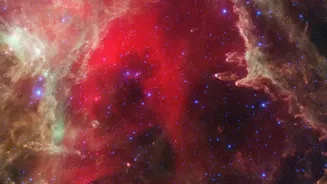
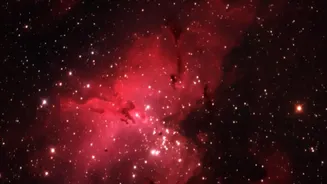
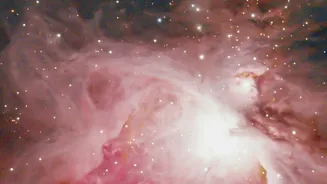
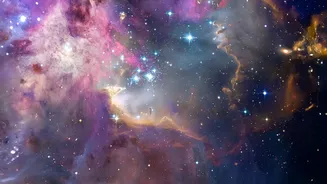
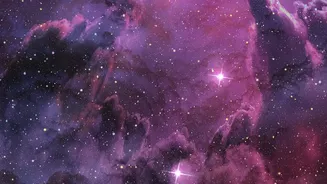
star begins its life inside a nebula, a giant cloud of gas and dust floating in interstellar space. These nebulae, often called 'stellar nurseries', are enormous, sometimes stretching hundreds of light-years across. They are composed mostly of hydrogen and helium, the primary building blocks of stars. While they appear majestic and serene in telescope images, these clouds are the staging grounds for one of the most powerful processes in the universe: star formation.
Gravity's Gentle Pull
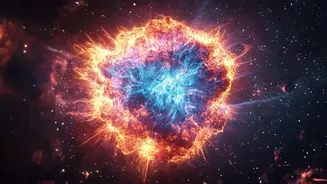
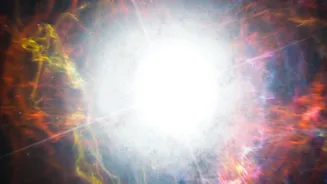
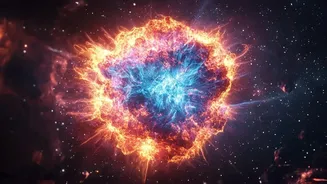
For a star to form, something needs to disturb the quiet calm of the nebula. This trigger can be a shockwave from a nearby exploding star (a supernova) or the gravitational pull of a passing star. This disturbance causes parts of the gas and dust cloud to clump together, creating pockets of higher density. Once a clump reaches a certain mass, its own gravity becomes strong enough to pull in more and more material, initiating a process known as gravitational collapse. Think of it as a cosmic snowball effect; as the clump grows, its gravitational pull gets stronger, and it grows even faster.
The Birth of a Protostar
As the cloud of gas and dust collapses, the material at the center gets squeezed incredibly tightly. This compression causes the core to heat up dramatically, creating a hot, dense object known as a protostar. A protostar is essentially a baby star. It glows, not because of nuclear fusion like a mature star, but from the heat generated by its ongoing gravitational contraction. Often, this glowing protostar is hidden from view, shrouded by the remaining dust and gas, which forms a rotating disc around it, known as an accretion disk. This disk continues to feed material to the growing protostar at its center.
Ignition: Let There Be Light
The protostar continues to pull in gas and dust from its surroundings, causing its core temperature and pressure to build over millions of years. Eventually, the core becomes so hot and dense—reaching a staggering 10 to 15 million degrees Kelvin—that a monumental event occurs: nuclear fusion ignites. At this point, hydrogen atoms begin to fuse together to form helium, releasing an immense amount of energy. This outward blast of energy counteracts the inward pull of gravity, creating a stable balance. This is the moment a protostar officially becomes a main-sequence star, like our own Sun, and begins to shine brightly.
Cleaning Up the Neighbourhood
Once the star ignites, it produces powerful stellar winds that blow away the remaining gas and dust from its immediate vicinity. These jets of gas often stream out from the star's poles, clearing the area and revealing the newborn star for the first time. The leftover material in the spinning accretion disk doesn't just disappear. Instead, these remnants of dust and gas can begin to clump together themselves, eventually forming planets, asteroids, and comets. In this way, the birth of a star often leads to the creation of an entire planetary system, much like our own solar system which formed from the leftovers of our Sun's birth over 4.5 billion years ago.