






A Telescope on a Continental Scale
The Square Kilometre Array (SKA) isn't a single telescope but a global megaproject in radio astronomy. It consists of two massive arrays spread across remote, radio-quiet deserts in South Africa and Australia. The name itself hints at its ambition: to
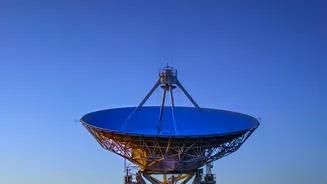
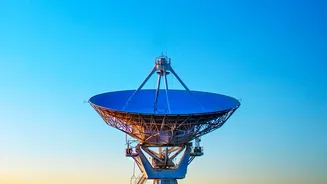
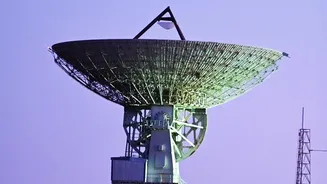
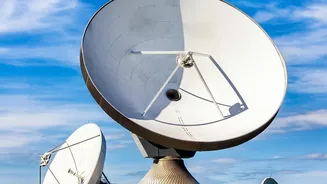
create a total collecting area of one square kilometre. In South Africa, the SKA-Mid array will feature nearly 200 large, 15-metre dishes observing mid-range radio frequencies. Meanwhile, in Western Australia, the SKA-Low array will comprise over 130,000 small, Christmas tree-like antennas designed to capture low-frequency signals. This dual-site approach allows astronomers to scan a huge portion of the sky across a wide range of frequencies, something no single instrument could achieve. Construction began in 2022, marking a new era for one of the 21st century's most significant international science projects, involving more than a dozen countries, including India.
The Power of Working Together
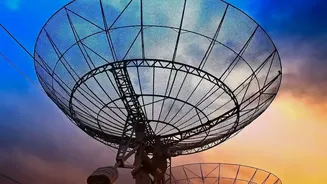
The secret to the SKA's power lies in a technique called interferometry. Instead of building an impossibly large single dish, astronomers link thousands of smaller antennas together with fibre optic cables. The signals from each antenna are sent to powerful central supercomputers—one in Cape Town and another in Perth—which combine the data. This process, known as aperture synthesis, allows the array to function as one virtual telescope with a diameter equal to the largest distance between any two antennas. For the SKA, this baseline will eventually stretch across thousands of kilometres. The technique works by measuring the tiny differences in the arrival time of a radio wave at each antenna. By calculating this 'phase offset', computers can pinpoint an object's position with incredible precision, achieving a resolution far greater than any individual dish could manage. The result is a telescope 50 times more sensitive than any previous radio instrument, capable of making sharper images and detecting fainter objects than ever before.
Listening for the Cosmic Dawn
So, what history is the SKA trying to capture? Its primary mission is to peer back more than 13 billion years to a period known as the 'Cosmic Dawn'. This is the era when the universe, then filled with neutral hydrogen gas, saw the birth of the very first stars and galaxies. The light from these first objects ionised the surrounding gas, leaving a faint signature that has been stretched over cosmic time into long-wavelength radio waves. The SKA is specifically designed to detect this faint signal, known as the 21-cm line, which has been travelling through space since the universe was in its infancy. By mapping this ancient hydrogen, scientists hope to create a 3D picture of how the first large-scale structures formed and answer fundamental questions about the universe's evolution. Other key science goals include testing Einstein's theories of gravity, understanding the nature of cosmic magnetism, and even searching for signs of extraterrestrial life.
A Data-Driven Revolution
The sheer amount of information the SKA will gather is staggering. The data flowing from the antennas to the central processors will be immense, generating more data in a single day than the entire global internet traffic. Processing this data requires some of the fastest supercomputers ever built and represents a significant engineering challenge in its own right. The project has driven advancements in high-performance computing, data management, and signal processing, with member nations like India contributing expertise and resources to handle the data deluge. This data will be made available to thousands of astronomers worldwide through a network of regional science centres. The construction is happening in phases, with early science operations expected to begin well before the array's final completion date around 2029. This incremental approach allows scientists to test systems and begin making discoveries even as the telescope continues to grow.