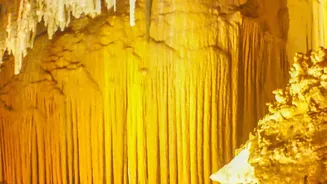








Venture into a limestone cave, and your eyes are drawn upward to the icicle-like rocks hanging from the ceiling. These formations, known as stalactites, seem to defy gravity. But how do they form? It is a slow, magical process of chemistry and time.
The Two Essential Ingredients
At
its heart, the creation of these hanging rock formations requires just two things: limestone and water. Limestone is a sedimentary rock made primarily of calcium carbonate. This is the mineral that ancient sea creatures used to build their shells and skeletons. Over millions of years, these remains were compressed into the rock that forms many of the world's most spectacular caves. The second ingredient, water, begins its journey as rain.
From Rainwater to Weak Acid
The process begins not in the cave, but in the sky and soil above it. As rainwater falls, it absorbs carbon dioxide from the atmosphere. It picks up even more carbon dioxide as it seeps through the topsoil, which is rich with decaying organic matter. When carbon dioxide dissolves in water, it forms a very weak solution of carbonic acid. While gentle, this acidic water is the key agent that carves out caves and builds their incredible decorations.
Dissolving the Rock
This slightly acidic water makes its way downward through cracks and fractures in the earth. When it reaches the limestone bedrock, a chemical reaction occurs. The carbonic acid dissolves the calcium carbonate in the rock, much like sugar dissolves in tea. The water now carries these dissolved minerals with it as it continues its journey deeper underground, eventually finding its way to the ceiling of a cave.
The Slow, Patient Drip
This is where the magic happens. When a drop of this mineral-rich water seeps through a crack in the cave ceiling and hangs there, it is exposed to the cave's air. The air in the cave has a lower concentration of carbon dioxide than the water does. This causes the carbon dioxide to be released from the water drop, which triggers a reversal of the previous chemical reaction. Unable to hold onto all its dissolved minerals, the water must leave a tiny amount behind.
Building a Stone Icicle
As drop after drop hangs and falls from the same spot, each one deposits a microscopic ring of calcite, which is recrystallized calcium carbonate. Over an immense amount of time, these rings build upon each other, extending downward to form a thin, hollow tube known as a 'soda straw'. If the central channel of this soda straw becomes blocked, water then flows down the outside, depositing more calcite and thickening the formation into the classic cone-shaped stalactite we recognise. This growth is incredibly slow, often averaging less than 10 cm every thousand years.
Meet the Family: Stalagmites and Columns
The process doesn't end at the ceiling. When the water drop falls to the floor, it still contains some dissolved calcite. As the drop splatters on the ground, more carbon dioxide is released, and another mineral deposit is formed. This creates an upward-growing formation called a stalagmite. A handy way to remember the difference is that stalactites hold 'tight' to the ceiling, while stalagmites 'might' one day reach the top. If a stalactite and a stalagmite grow for long enough, they can meet in the middle, fusing into a single, majestic pillar known as a column.