



The Coolest Lab in the Universe
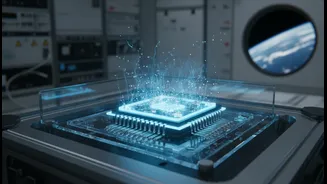
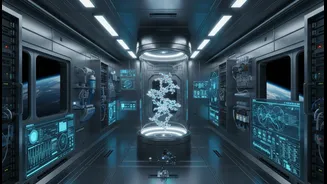
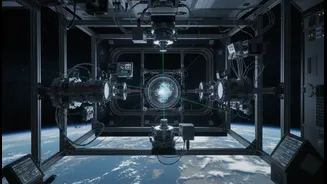
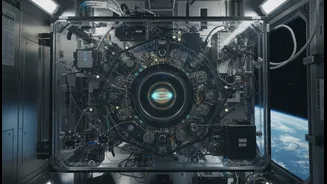
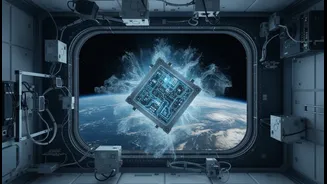
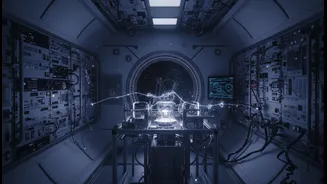
The facility at the heart of this research is NASA's Cold Atom Laboratory (CAL). Launched to the International Space Station in 2018, its purpose is to create temperatures just a fraction of a degree above absolute zero (minus 273.15 degrees Celsius).
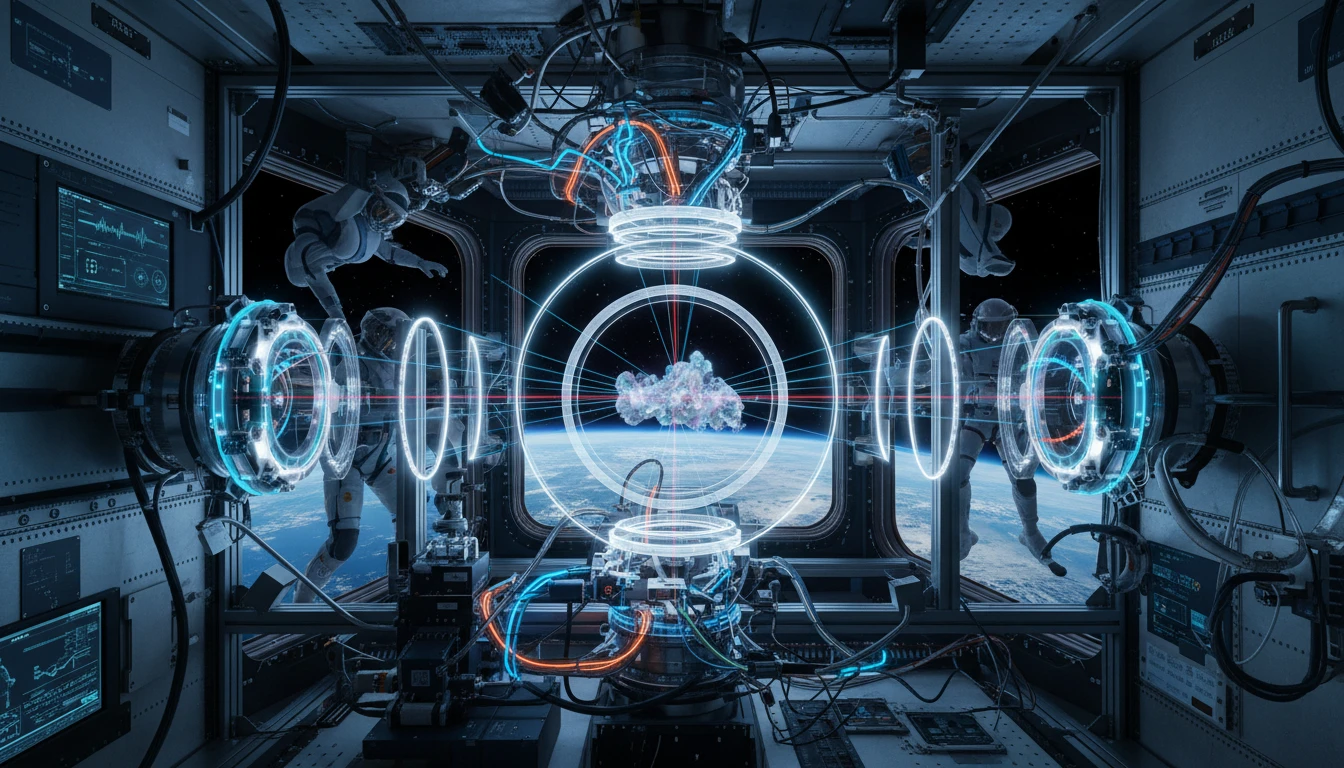
At these extreme temperatures, atoms slow to a crawl and begin to behave in ways that defy classical physics. They can form a bizarre fifth state of matter called a Bose-Einstein Condensate (BEC), where the atoms lose their individual identities and act like a single, massive quantum wave. This allows scientists, who control the lab remotely from Earth, to observe quantum phenomena on a macroscopic scale.
Why Space is the Perfect Laboratory
Conducting these experiments on Earth is incredibly challenging. Gravity constantly pulls on the atom clouds, causing them to collapse in fractions of a second. This limits how long scientists can observe these delicate quantum states. By operating in the microgravity environment of the ISS, the Cold Atom Lab provides a 'free-fall' environment. This allows the weakly-held atom clouds to expand and exist for much longer periods—up to several seconds—giving researchers a clearer and longer window into their behaviour. The absence of strong gravitational pull also enables the lab to achieve even colder temperatures than is possible in ground-based facilities.
A Significant Power Boost
In mid-2026, astronauts aboard the ISS installed the fourth major hardware upgrade to the CAL since its deployment. This latest enhancement significantly boosts its capabilities. Key improvements include a newly designed magnetic trap, which gives scientists more precise control over the shape of the quantum gas clouds. Engineers also installed improved atom sources and enhanced measurement tools. These upgrades, which were launched to the station in April 2026 and activated recently, allow researchers to push deeper into the quantum realm, essentially expanding the boundaries of what can be studied in this unique environment.
Unlocking New Quantum Mysteries
So, what does this increased power mean for science? The new tools allow researchers to create and manipulate quantum gases in ways that were previously impossible. They can study new types of atomic interactions and test fundamental theories of physics, such as Einstein's equivalence principle, with greater precision. The ability to observe these phenomena for longer in microgravity is critical for moving from simply observing them to using them as tools. As one JPL scientist put it, this next step is about performing 'Quantum 2.0'—the direct manipulation of large quantum states to develop new technologies.
From Space Station to Daily Life
While studying ultracold atoms in space sounds abstract, the applications could have a profound impact back on Earth. This fundamental research is paving the way for a new generation of ultra-precise quantum sensors. Imagine future versions of GPS that can navigate on the Moon or deep in the ocean without satellite signals, or 'gravitational cameras' that can map underground water sources, find mineral deposits, or monitor volcanoes with unprecedented accuracy. This work also lays the foundation for more robust quantum computers and ultra-stable atomic clocks that could improve everything from financial networks to space navigation. The experiments on the ISS are a crucial step toward turning these futuristic ideas into reality.