
The Ultimate Insurance Policy
The Crew Escape System (CES) is a critical safety feature designed to pull the crew module and its astronauts away from the launch vehicle in case of a catastrophic failure on the launchpad or during ascent. Think of it as a highly sophisticated ejection
seat, not for a single pilot, but for an entire capsule. Its sole purpose is to ensure that even if the multi-million dollar rocket is lost, the crew survives. This philosophy is the bedrock of human spaceflight, where astronaut safety is the absolute highest priority. The system constantly monitors the rocket's health and can automatically trigger an abort within milliseconds of detecting a problem, like a loss of thrust or a dangerous deviation from its flight path.
Anatomy of a Split-Second Escape
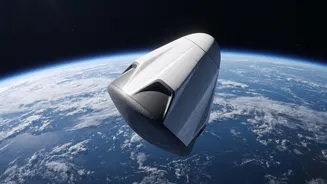
The Gaganyaan's CES is a 'puller' type system, consisting of an assembly with powerful, quick-acting solid rocket motors positioned on a tower above the crew module. In an emergency, pyro-technic bolts fire to sever the connection to the main rocket. Simultaneously, the high-burn-rate escape motors ignite, generating immense thrust to rapidly pull the crew module away from the danger zone. These motors are designed to accelerate faster than the launch vehicle itself, yanking the astronauts to safety. After the motors burn out, the escape tower is jettisoned. The crew module then follows its own automated sequence, deploying parachutes for a safe splashdown in the sea.
Two Critical Abort Scenarios
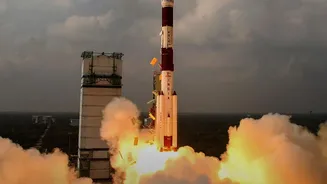
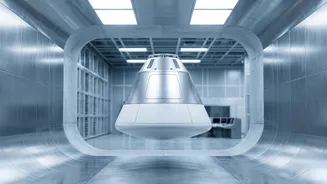
ISRO has meticulously planned for emergencies at every stage of the launch. The two most critical scenarios are a Pad Abort and an In-flight Abort. A Pad Abort Test (PAT), successfully conducted in July 2018, simulated an emergency while the rocket is still on the launchpad. In this test, the CES fired to lift the 12.6-tonne crew module to an altitude of 2.7 km before it parachuted safely into the Bay of Bengal. The second scenario is an in-flight abort during the atmospheric ascent, when the rocket is travelling at supersonic speeds and experiencing maximum aerodynamic pressure. This is arguably the most challenging escape scenario.
Progress Through Rigorous Testing
Demonstrating the in-flight abort capability has been a key focus of ISRO's recent progress. The Test Vehicle Abort Mission-1 (TV-D1), conducted in October 2023, was a landmark success. A specially designed single-stage liquid rocket launched with a full-scale uncrewed crew module. The flight simulated an abort at a speed of Mach 1.2 and an altitude of about 11.7 km. The CES performed perfectly, pulling the module away from the test vehicle. The crew module continued to an altitude of 17 km before beginning its parachute-assisted descent for a successful recovery by the Indian Navy. This test validated the entire sequence, from abort trigger to crew module recovery, proving the system's reliability under extreme conditions.
The Human Factor
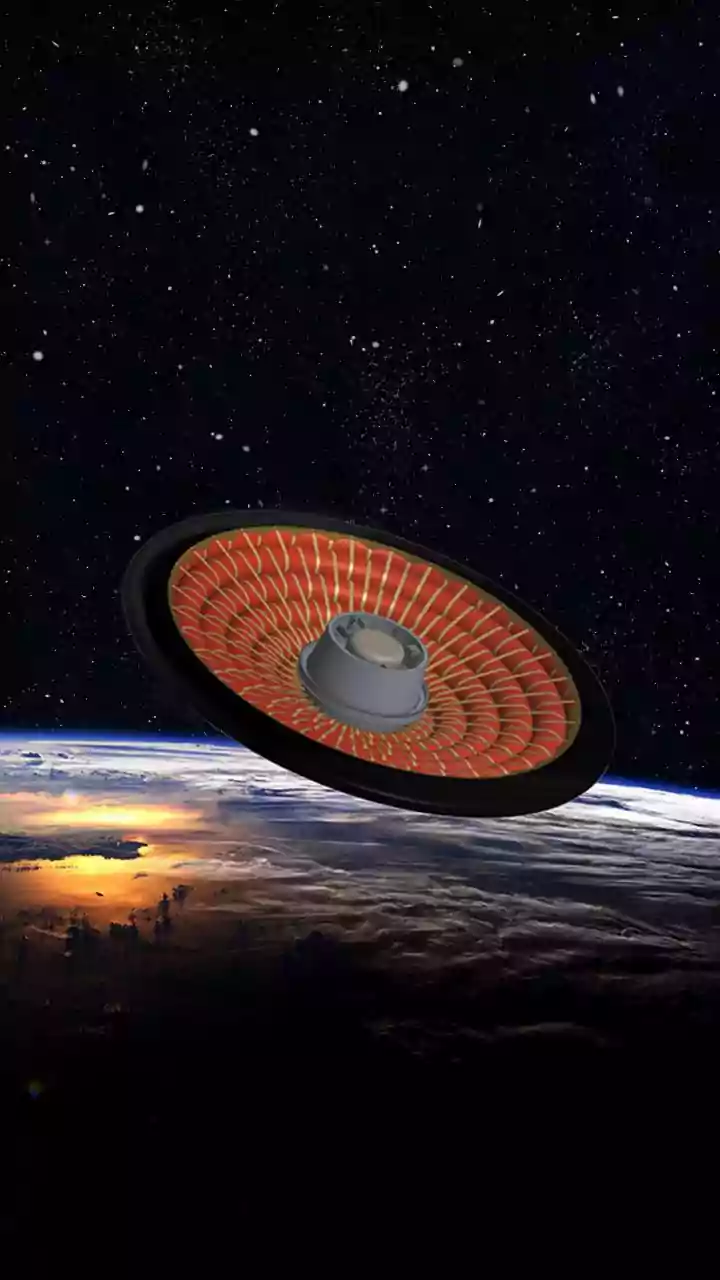
Surviving an escape is a violent experience. The acceleration can subject astronauts to forces up to 10 times that of gravity. The design of the Gaganyaan capsule and astronaut seating is engineered to help humans withstand these forces. Astronauts will be positioned lying on their backs, an orientation that allows the body to tolerate the immense G-forces by pressing them back into their seats, rather than forcing blood away from the brain. Furthermore, the entire deceleration process is carefully managed. The module uses a sequence of 10 parachutes in total, starting with drogue chutes to stabilise and slow the capsule from high speeds, followed by the main parachutes to ensure a gentle splashdown. Every element is designed to make an inherently dangerous situation survivable.