

A Panoramic View of the Cosmos
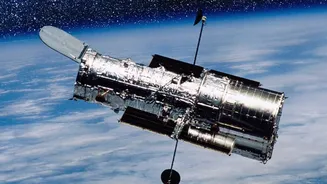
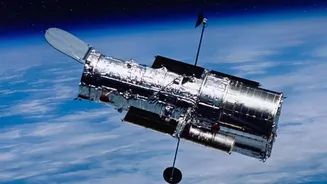
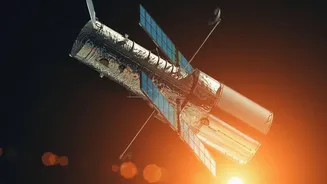
Imagine trying to take a picture of a sprawling city skyline through a keyhole. That’s been the challenge for many powerful telescopes, including the Hubble Space Telescope. While they provide incredibly sharp, deep images, their field of view is narrow.
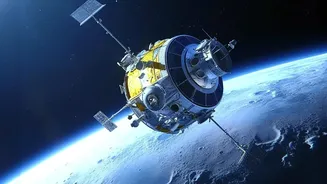
The Roman Space Telescope, scheduled for launch on August 30, 2026, changes the game. It features the same size primary mirror as Hubble—2.4 meters in diameter—but its Wide Field Instrument (WFI) will capture a patch of sky over 100 times larger in a single shot. This means Roman can survey the sky at a rate 100 to 1,500 times faster than Hubble, creating vast, high-resolution cosmic maps. While the James Webb Space Telescope (JWST) is designed to peer deeper into the universe's infancy with extreme sensitivity, Roman is built for breadth, tasked with creating the big picture that Webb and Hubble can then inspect in greater detail.
Hunting the Universe's Biggest Mysteries
About 95% of the universe is made of dark matter and dark energy, mysterious components that we cannot see or directly detect. Scientists know they exist because of their gravitational effects on the matter we can see. Dark energy is the force believed to be causing the universe's expansion to accelerate, while dark matter provides the extra gravitational pull that holds galaxies together. The Roman Telescope's primary mission is to tackle these profound puzzles. By surveying over a billion galaxies across cosmic time, Roman will map the large-scale structure of the universe. This massive survey will allow scientists to study how dark energy and dark matter have influenced the evolution and clustering of galaxies over billions of years, providing crucial data to test theories about their fundamental nature.
A New Way to Find Alien Worlds
Since the 1990s, astronomers have confirmed thousands of exoplanets, or planets orbiting other stars. Roman is expected to dramatically increase that number, potentially discovering thousands more on its own. It will do this primarily using a technique called gravitational microlensing. This phenomenon occurs when a star or planet passes almost directly in front of a more distant background star from our perspective. The gravity of the closer object acts like a natural magnifying glass, briefly amplifying the light of the distant star. If the foreground star has a planet, the planet’s own gravity creates a secondary, smaller spike in brightness. This method is particularly effective for finding planets far from their star, in orbits similar to Jupiter or Saturn, and even free-floating planets that have been ejected from their home systems. This will provide a crucial census of colder, more distant planets to complement the discoveries of missions like Kepler, which were biased towards planets in tight orbits.
Directly Imaging Giant Planets
In addition to its powerful wide-field camera, Roman carries a second instrument: the Coronagraph Instrument. This technology is designed to demonstrate a new way of directly imaging exoplanets. A coronagraph works by blocking the overwhelming glare of a host star, allowing the much fainter light from an orbiting planet to be seen. This is like blocking the sun with your hand to see something next to it. Roman’s coronagraph will be a technological stepping stone, capable of taking direct pictures of large, Jupiter-sized planets and the dusty debris disks where planets form. The lessons learned from this instrument will be invaluable for future missions designed to directly image smaller, rocky, Earth-like planets within their star’s habitable zone.