






The dream of a human footprint on Mars is as old as the space age itself. But the debate over how to get there has often pitted human explorers against their robotic counterparts. Now, that conversation is changing from 'either/or' to 'how'.
The Classic Case for Robots
For decades,
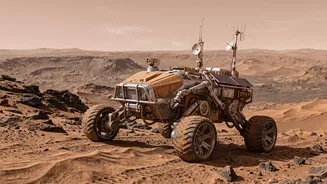
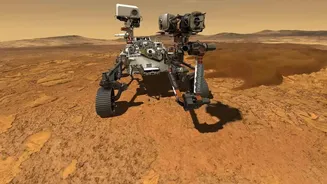
the argument for prioritizing robotic exploration has been compelling and straightforward. Robots don't need to eat, breathe, or sleep. They are immune to the life-threatening dangers of space radiation and the physiological toll of long-duration spaceflight, such as muscle atrophy and bone density loss. Sending a machine to Mars is also drastically cheaper. A robotic mission like the Perseverance rover costs a fraction of a crewed mission, which is estimated to potentially run into the hundreds of billions of dollars. Robots can be built to withstand extreme environments, don't require a return ticket, and can operate for years, patiently gathering data. These uncrewed missions have been fundamental, mapping the Martian surface, analysing the atmosphere, and giving us our first real understanding of the Red Planet.
The Irreplaceable Human Element
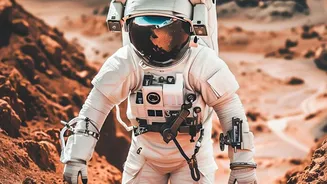
Despite the efficiency of robots, they lack a crucial component: human ingenuity. While a rover like Curiosity moves at a crawl, an astronaut could cover the same ground exponentially faster. Humans are adaptable problem-solvers, capable of making intuitive leaps and conducting complex experiments in real-time without the significant communication delays between Earth and Mars. A human geologist can identify a promising rock sample, decide to investigate it, and perform an initial analysis on the spot—a process that could take a rover weeks of commands from mission control. This ability to react, improvise, and apply a lifetime of experience is something that even the most advanced AI cannot yet replicate. Exploration, advocates argue, is not just about data collection; it's a human endeavor, driven by curiosity and the promise of discovery.
A New Paradigm: Robots as Advance Scouts
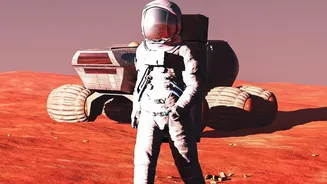
The debate is no longer a simple contest between man and machine. Instead, space agencies like NASA are embracing a new, integrated strategy: using robots as precursors to pave the way for human explorers. This 'Moon to Mars' approach treats robotic missions as essential reconnaissance. The goal is to use robots to fill 'Strategic Knowledge Gaps'—critical information needed to reduce the risks for future astronauts. These robotic scouts are tasked with preparing the landing zone, testing key technologies, and identifying resources, effectively rolling out a welcome mat for the first human crews. This shifts the dynamic from a rivalry to a powerful partnership.
Paving the Way on the Red Planet
So what does this robotic prep work actually look like? NASA's Perseverance rover offers a clear blueprint. One of its key experiments, the Mars Oxygen In-Situ Resource Utilization Experiment (MOXIE), has successfully demonstrated that it can produce oxygen from the thin Martian atmosphere. This is a game-changing capability for future missions, potentially providing breathable air for astronauts and producing rocket propellant for the journey home. Rovers are also helping to characterize the radiation environment on the surface, testing how different materials hold up over time, and identifying natural shelters like cliffs or lava tubes that could protect human habitats. Future robots could even be used to pre-deploy habitats and build infrastructure before the first humans ever leave Earth.
The Synergistic Future of Exploration
Looking ahead, the collaboration will only deepen. Future scenarios involve astronauts on the surface or in orbit around Mars directly controlling highly dexterous rovers and drones in real-time, sending them into hazardous craters or canyons that are too risky for humans. This combines human decision-making with robotic resilience. The European Space Agency has already run successful tests with astronauts on the International Space Station controlling rovers on Earth to simulate this very concept. Robots will handle the dangerous, repetitive, and physically demanding tasks, freeing up human crew members to focus on complex scientific investigation and discovery. It's a model that leverages the best of both worlds—the durability of machines and the adaptable intellect of human explorers.