





The Science of Sensation
That irresistible feeling you get from combining two opposite textures has a name: dynamic sensory contrast. Food scientists and psychologists have studied this phenomenon for years, and it’s one of the most powerful tools in creating hyper-palatable
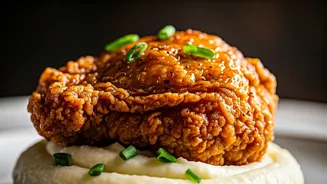
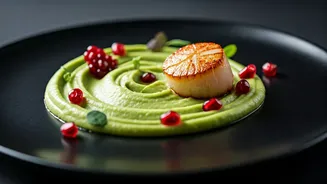
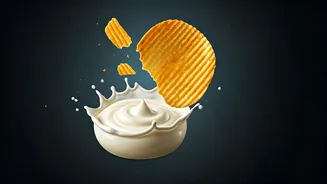
foods. Our mouths, and by extension our brains, are easily bored. A single, uniform texture, whether it’s just mushy or just crunchy, leads to what experts call “sensory-specific satiety.” Essentially, your brain gets enough of that one sensation and sends signals to stop eating. But when you introduce contrast—a crisp potato chip plunging into a smooth, creamy dip, or the crackle of a choco-bar shell revealing a molten caramel core—you create a more complex and engaging experience. Each bite is a small surprise. The brain doesn’t get bored; instead, it stays highly stimulated, which can override the body’s natural fullness cues. This contrast keeps you coming back for “just one more,” as your brain continues to seek that delightful textural interplay.
Your Brain on Crunch
The effect is not just psychological; it's deeply neurological. When we eat foods with dynamic sensory contrast, our brains release a rush of dopamine, the neurotransmitter associated with pleasure and reward. The sound and feeling of a crunch is an event. It signals to the brain that something interesting is happening. When that crunch is immediately followed by a smooth, rich, or creamy sensation, the brain registers it as a doubly rewarding experience. It’s like a tiny firework show in your mouth, and your brain’s reward centre lights up in response.
This dopamine response is the same mechanism involved in other rewarding behaviours, which is why the term “addictive” is often used. While not a true addiction in the clinical sense, the neurochemical feedback loop is powerful. Your brain quickly learns to associate that specific food combination with a feeling of intense pleasure, creating a strong craving to repeat the experience. It’s a powerful driver of why we reach for that bag of chips or box of cookies, even when we’re not truly hungry.
An Evolutionary Echo
Our preference for textural variety isn't just a modern quirk; it has deep evolutionary roots. For our ancestors, food texture provided crucial information about safety and nutritional value. A crunch could signify freshness in a plant or the crispness of a cooked food, indicating it was free from rot. A soft or creamy texture, on the other hand, often signalled a high concentration of fat and calories—a valuable energy source in a world of scarcity. Think of ripe fruit, bone marrow, or rich nuts.
Therefore, a food that offered both crunch and creaminess would have been an evolutionary jackpot. It suggested a food that was both fresh (crunch) and energy-dense (cream). Our brains are still wired with this ancient survival software. We instinctively perceive these combinations as more satisfying and desirable because, for millennia, they represented the best possible nutrition. Today, that programming is being expertly targeted by foods that offer the sensory cues of nutrition without necessarily providing it.
Engineered for Cravings
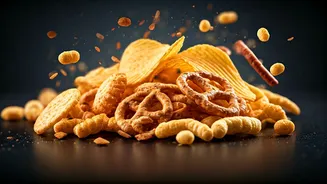
Food manufacturers are masters of dynamic sensory contrast. This isn't a happy accident; it’s a deliberate design principle used to make products moreish and commercially successful. The modern supermarket is a testament to this science. Consider the layered crunch of a biscuit like a Bourbon or the inside of a KitKat. Think about ice cream loaded with cookie dough, chocolate chips, or crunchy nut clusters. Even savoury items like a paneer tikka pizza, with its soft cheese and crispy base, or a dahi puri, with its brittle shell and soft yogurt filling, play on this principle.
Food technologists, often called “craveability experts,” spend millions of rupees fine-tuning the “mouthfeel” of their products. They engineer the exact fracture point of a potato chip, the precise melt rate of chocolate, and the ideal ratio of crunchy bits in a creamy matrix. By maximizing dynamic sensory contrast, they can create a product that keeps you engaged and bypasses your off-switch, encouraging you to finish the whole packet.