
The Unseen Vulnerability in the Sky
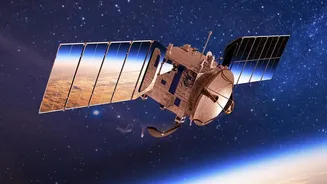
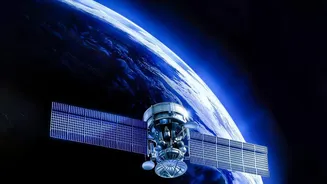
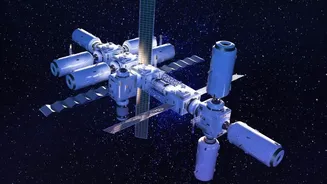
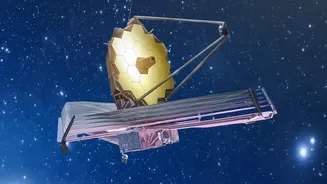
We rarely think about it, but a vast and invisible infrastructure of satellites underpins daily life. These orbital assets are crucial for everything from in-flight Wi-Fi and cellular service in remote areas to sensitive military operations and global
financial systems. For decades, security has relied on classical encryption—complex math problems that are incredibly hard for today's computers to solve. The problem is, two threats are emerging. First, recent studies have shown that a shocking amount of satellite data is transmitted without any encryption at all, vulnerable to interception with relatively cheap, off-the-shelf equipment. Second, the rise of quantum computers threatens to make even our best current encryption obsolete, capable of solving those 'unsolvable' math problems with ease. This creates a future risk where data we believe is secure today could be harvested now and decrypted later.
Quantum Communication 101
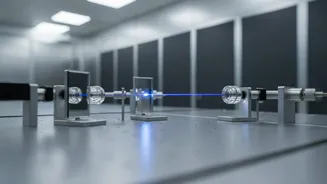
Enter quantum communication, a system that doesn't rely on mathematical difficulty for its security. Instead, it uses the fundamental laws of physics. The most developed application is called Quantum Key Distribution, or QKD. Think of it this way: instead of creating a complex digital lock, you're sending a physical key. But this key is made of individual particles of light, called photons. Each photon is prepared in a specific quantum state (like its polarization) to represent a 1 or a 0. Together, a stream of these photons forms a secret key that both the sender and receiver can use to encrypt and decrypt their messages. The data itself is still sent over a classical channel, but the key to unlock it is quantum-secured.
The Unhackable Handshake
Here's where the 'unhackable' part comes in, and it's based on a principle in quantum mechanics called the 'observer effect'. The very act of observing a quantum particle inevitably changes it. Imagine you and a friend are sharing a secret key by sending a stream of incredibly fragile, specially-aligned photons between you. If an eavesdropper tries to intercept and measure those photons to learn the key, their measurement will disturb the photons' delicate quantum states. This disturbance creates detectable errors in the sequence. The sender and receiver can then publicly compare a small portion of their key. If they see a high error rate, they know someone is listening in. They immediately discard that key and generate a new one. The eavesdropper is caught, and the compromised key is never used, ensuring the communication remains secure.
From Theory to Orbit
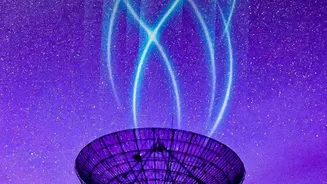
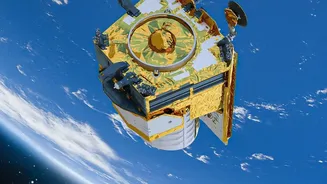
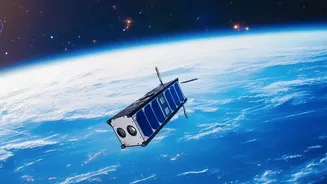
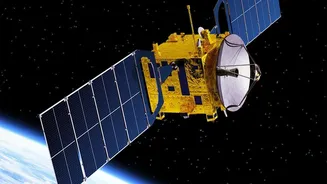
This isn't just science fiction. China launched the world's first quantum communications satellite, named Micius, in 2016. In the years since, scientists have used it to perform groundbreaking experiments, including distributing quantum keys between the satellite and ground stations thousands of kilometers apart. They even successfully hosted a quantum-encrypted video conference between Beijing and Vienna, a distance of over 7,600 km, using the satellite as a trusted relay node. These demonstrations proved that satellite-based QKD is a viable solution to overcome the distance limitations of fiber-optic cables, which can only transmit quantum signals for a few hundred kilometers before the signal degrades. Following this success, Europe and the U.S. are accelerating their own programs, with the European Space Agency planning its own QKD satellite launches and the U.S. government exploring quantum technologies for military and navigation purposes.
The Quantum Frontier Ahead
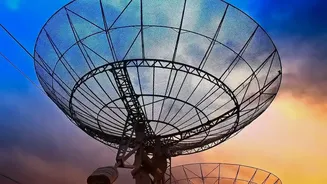
Despite these incredible advances, a global quantum-secured internet is still on the horizon. The challenges are significant. Building and launching satellites with delicate quantum hardware is expensive. The systems must be incredibly precise to aim a beam of single photons from a satellite moving at thousands of miles per hour to a ground station telescope. Furthermore, factors like atmospheric turbulence and even daylight can disrupt the fragile signals. The current generation of technology still requires the satellite to act as a 'trusted node,' meaning you have to trust that the satellite itself hasn't been compromised. Future systems aim to use quantum entanglement to create keys without this vulnerability. For now, the race is on to build smaller, more efficient satellites and a robust network of ground stations to make this revolutionary technology a practical tool for governments, banks, and corporations worldwide.