


The Right Place: The 'Goldilocks Zone'
The first and most famous criterion is location. A planet must orbit its star in what is called the 'habitable zone', nicknamed the 'Goldilocks zone'. This is the orbital range where temperatures are not too hot and too cold, but just right for liquid
water to potentially exist on the planet's surface. Liquid water is considered a fundamental requirement for life as we know it, acting as a solvent where the chemical reactions necessary for life can occur. Every star has a habitable zone, but its size and distance depend on the star's brightness and heat. A dimmer, cooler star will have a habitable zone much closer to it than a large, bright star like our sun.
The Right Size: Rocky and Not Too Big
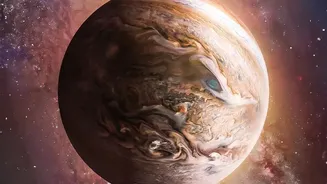
Not just any planet in the habitable zone will do. Astronomers focus on rocky, terrestrial planets similar in size to Earth. Planets that are too small can't hold onto a substantial atmosphere, while those that are too large tend to become gas giants like Jupiter or 'mini-Neptunes'. These massive worlds accumulate thick, crushing atmospheres of hydrogen and helium, and they lack a solid surface. Scientists generally look for planets less than 1.6 times the radius of Earth, as worlds larger than this are likely to have become gas-rich planets where Earth-like life would be impossible.
The Right Star: A Stable and Long-Lived Parent
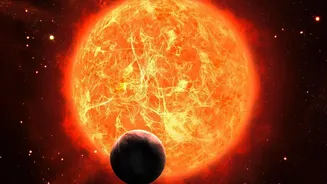
The type of host star is crucial. While planets are easier to spot around smaller, dimmer red dwarfs, these stars can be volatile, blasting their nearby planets with intense radiation that could strip away atmospheres and sterilise the surface. Larger, more massive stars burn out too quickly, perhaps not allowing enough time for complex life to evolve. Some scientists believe the 'sweet spot' may be K-type stars, or orange dwarfs. These are calmer than red dwarfs but live for tens of billions of years, far longer than sun-like stars, providing a stable environment for life to potentially emerge and thrive.
The Right Protection: An Atmosphere and Magnetic Field
A suitable atmosphere is non-negotiable. It protects the surface from harmful stellar radiation, regulates temperature across the planet, and maintains the pressure needed for liquid water to remain stable. Without an atmosphere, any surface water would quickly boil away into space. To study this from light-years away, astronomers use a technique called transit spectroscopy. When a planet passes in front of its star, the starlight filtering through its atmosphere is altered, and powerful instruments like those on the James Webb Space Telescope can read these changes to identify the gases present. A protective magnetic field, like Earth's, is another highly desirable trait to shield the atmosphere from being eroded by the star's solar wind.
The Telltale Signs: Searching for Biosignatures
The ultimate goal is to find 'biosignatures'—gases in the atmosphere that are strong indicators of biological processes. On Earth, the most prominent biosignature is the high concentration of oxygen, a reactive gas that is constantly replenished by photosynthesis. The simultaneous presence of gases that shouldn't coexist, like oxygen and methane, is an even stronger sign, suggesting a living process is actively maintaining this chemical imbalance. Future telescopes will search for these gases, such as oxygen, ozone, methane, and even industrial pollutants like methyl chloride, which could be a sign of a technological civilization.