




A New Paradigm in Sky-Watching
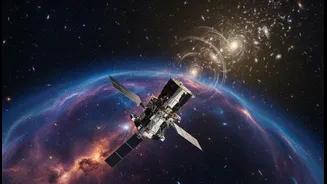
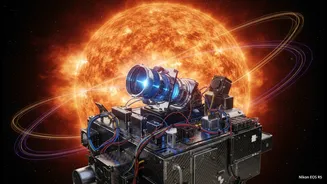
Set to launch by May 2027, the Nancy Grace Roman Space Telescope is poised to revolutionize how we see the universe. While telescopes like Hubble provide incredibly deep and detailed views of small patches of the sky, Roman is designed for breadth and speed.
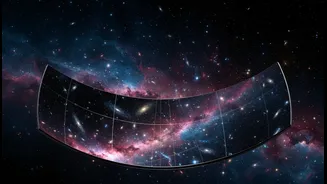
Its primary mirror is the same size as Hubble's, but its Wide Field Instrument gives it a field of view at least 100 times larger. This allows Roman to survey the sky up to 1,000 times faster than Hubble, capturing vast cosmic panoramas with similar sharpness. Instead of focusing on one target for a long time, Roman will repeatedly scan large sections of the sky, building a dynamic map of the cosmos and how it changes over time.
Hunting for Cosmic Ghosts
Many of the most scientifically interesting events in the universe are incredibly rare or brief. These are often called 'transient' events. For example, the signal from a rogue planet—a world drifting through space without a star—can last from just a few hours to a couple of days before it's gone forever. Similarly, tidal disruption events (TDEs), where a star is torn apart by a black hole, are powerful but infrequent occurrences. Finding them with traditional telescopes is like trying to photograph a specific lightning strike in a massive storm. Roman's strategy is different: it will photograph the entire storm continuously. By repeatedly imaging the same patch of sky, it can spot these fleeting changes in brightness against the static backdrop of distant stars.
A Catalog of Fleeting Phenomena
Roman's speed will enable it to build an unprecedented catalog of transient events. Simulations predict that in just its first few years, the telescope's High-Latitude Time-Domain Survey could detect tens of thousands of cosmic explosions. This includes thousands of Type Ia supernovae, which are crucial for measuring the expansion of the universe. Scientists also expect to find thousands of rogue planets through a technique called gravitational microlensing, where the planet's gravity briefly magnifies the light of a distant star. Some studies predict Roman could find as many as 400 Earth-mass rogue planets, giving us the first real census of these lonely worlds. It will also spot rarer events, like kilonovae from merging neutron stars and superluminous supernovae.
The Data Deluge Challenge
This incredible survey speed comes with its own challenge: a massive amount of data. Roman is expected to generate enormous datasets, with all observations becoming publicly available almost immediately. In its first five years, it could produce over 2,500 terabytes of data, far surpassing what Hubble has collected in over three decades. Finding a single, hours-long event within this deluge requires sophisticated, automated systems. Teams are currently developing software and data processing pipelines to handle the flow of information. These systems will sift through the images, flag potential transient events, and alert astronomers around the world, allowing for rapid follow-up observations with other telescopes like the James Webb Space Telescope.