


Seeing the Invisible Universe
When we look at the night sky, our eyes see a narrow band of light called the visible spectrum. But this is just a tiny fraction of the information the universe is sending our way. The full range of light, known as the electromagnetic spectrum, includes
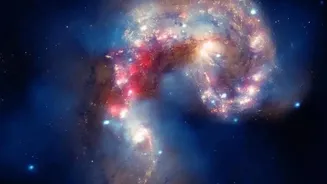
everything from low-energy radio waves and microwaves to high-energy ultraviolet, X-rays, and gamma rays. Multiwavelength astronomy is the science of using different telescopes to capture these various forms of light, each of which reveals unique cosmic processes and objects that would otherwise be invisible. By combining these different views, astronomers can piece together a much richer and more dynamic understanding of a galaxy's life.
The Familiar: Visible and Ultraviolet Light
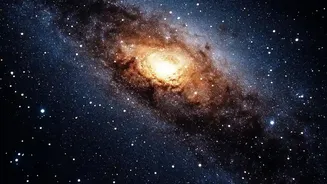
A standard optical telescope shows us a galaxy much like our eyes would, if they were powerful enough. We see the combined glow of billions of stars, often crossed by dark lanes of cosmic dust that block the starlight behind them. Shifting to slightly higher-energy ultraviolet (UV) light reveals a different story. Since the hottest, youngest, and most massive stars burn brightest in UV, this view allows astronomers to map out the galaxy's most active star-forming nurseries. Regions that might look calm in visible light can appear as blazing hotspots in the ultraviolet, tracing the galaxy's most energetic and short-lived stellar residents.
Infrared: Peering Through the Dust
Those dark dust lanes that obscure our view in visible light become transparent when viewed in the infrared. Infrared light has longer wavelengths that can pass through cosmic dust, allowing telescopes like the James Webb Space Telescope to peer into the dense clouds where new stars and planets are born. This light reveals the warm glow of dust heated by starlight and the faint light from cooler, smaller stars. What appears as a dark, empty patch in an optical image can be a vibrant, glowing stellar nursery when seen through infrared eyes.
X-Rays: A Universe of Violence and Heat
To see the most violent and energetic events, astronomers turn to X-ray telescopes like NASA's Chandra X-ray Observatory. X-rays are produced by matter heated to millions of degrees, conditions found in only the most extreme environments. An X-ray view of a galaxy cuts through the soft glow of stars and instead highlights the chaos. We can see matter superheating as it's pulled into a supermassive black hole at the galaxy's core, the remnants of exploded stars (supernovae), and powerful jets of particles shot into space at nearly the speed of light. These are phenomena that are completely invisible in other wavelengths.
Radio Waves: The Cold, Gassy Fuel
On the other end of the spectrum, radio telescopes reveal the universe's coldest components. Instead of stars, they map vast clouds of cold hydrogen gas—the raw fuel for future star formation. By tracing this gas, astronomers can understand a galaxy's potential for growth and see the large-scale structures that connect everything. Radio waves also reveal different aspects of high-energy events, such as the enormous lobes and jets of material powered by a central black hole, which can extend far beyond the visible confines of the galaxy itself.
A Case Study: Centaurus A
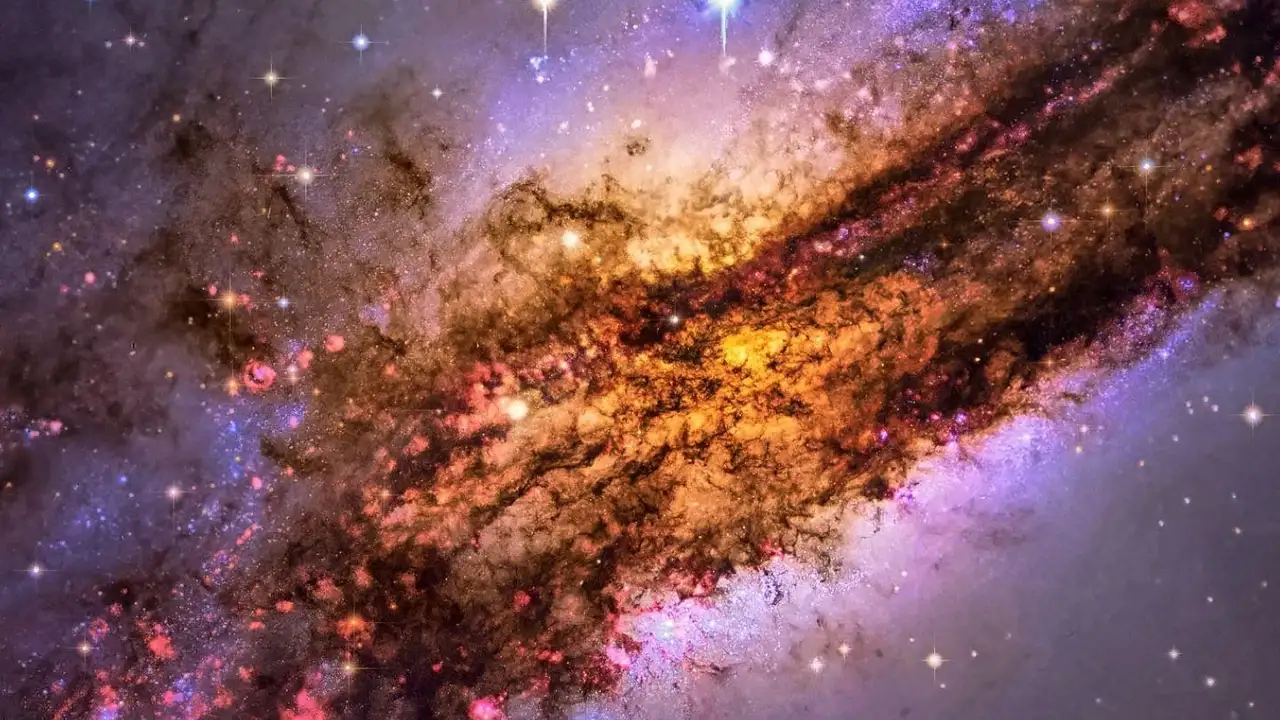
The galaxy Centaurus A provides a perfect example of why this composite approach is so crucial. In visible light, it looks like a large elliptical galaxy sliced in half by a thick, dark dust lane. In the infrared, we see through that dust to the glow of a warped inner disk of stars, hinting at a past galactic merger. The X-ray view reveals a powerful jet of high-energy particles streaming from the supermassive black hole at its core. And in radio wavelengths, we see that this jet extends into enormous lobes of gas that dwarf the visible galaxy. None of these individual views tells the whole story. Only by combining them do we get the complete picture of a dynamic, evolving galaxy with a violent heart.