


The Martian Garden Problem
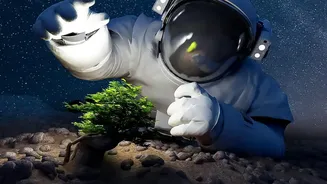
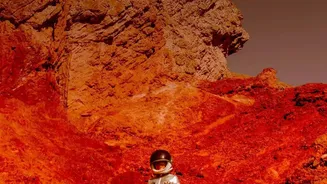
While science fiction films like 'The Martian' make growing potatoes on the Red Planet look challenging but achievable, the reality is far more complex. Future Mars colonists won't find fields ready for tilling. Instead, they'll face an environment actively
hostile to nearly all forms of Earth-based agriculture. The challenges extend from the very ground beneath their feet to the air, or lack thereof, and the sky above. Overcoming these hurdles is essential for any long-term human presence, as it's not feasible to continuously ship food across 140 million miles of space. Success requires a new kind of agriculture, one adapted for an entirely different world.
The Toxic Soil
The first major barrier is the Martian "soil" itself. On Mars, it isn't truly soil but regolith: a layer of loose mineral dust and rock that contains no organic matter. Worse, this regolith is laced with a class of toxic salts called perchlorates. At concentrations found on Mars, these compounds are harmful to plants and humans, capable of interfering with the thyroid gland. Any attempt to use Martian regolith for farming would first require a detoxification process. Researchers are exploring methods like rinsing the soil, a water-intensive process, or using microbes that can break down perchlorates.
Thin Air and Deep Cold
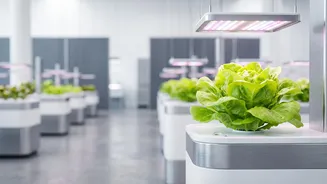
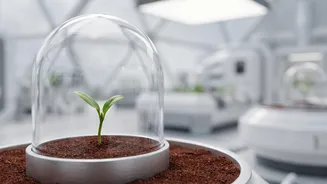
Mars has a very thin atmosphere, about 1% as dense as Earth's, and an average temperature of a frigid -80°F (-62°C). These conditions make it impossible to grow crops outdoors. Plants would need to be cultivated inside pressurized, heated greenhouses. But even inside, the lower gravity and different atmospheric composition present challenges. Systems like hydroponics and aeroponics, which grow plants in nutrient-rich water solutions or mists without soil, are promising alternatives being heavily researched. They use less water and can grow plants faster than traditional farming, making them well-suited for controlled environments.
The Radiation Factor
Earth's magnetic field and thick atmosphere protect us from the harsh radiation of space. Mars has no global magnetic field, leaving its surface exposed to intense cosmic and solar radiation that can damage plant DNA and stunt growth. Studies have shown that even simulated Martian radiation levels lead to smaller harvests and damaged leaves. To protect crops, greenhouses on Mars would likely need to be shielded, perhaps by being built underground. This would solve the radiation problem but create another: the need for powerful, efficient artificial lighting to replace the sun.
Enter the Next Generation
These seemingly insurmountable challenges are exactly what make Martian agriculture a perfect subject for students. Programs like the NASA-sponsored 'Growing Beyond Earth' and the 'Conrad Challenge' invite middle school, high school, and university students to tackle these real-world problems. These budding scientists are not just writing papers; they are building prototypes, testing soil simulants, and contributing valuable data to NASA. For example, a team of Texas students recently designed a system called 'Gaia's Outpost' to process toxic Martian regolith. Other students are studying how to use bacteria to naturally fertilize the soil or developing closed-loop hydroponic systems to recycle every drop of water and nutrient. These projects provide hands-on experience in solving complex multidisciplinary problems, blending biology, engineering, and chemistry.
Why This Research Matters
Studying how to grow food on Mars does more than prepare us for space exploration; it pushes us to develop more sustainable agriculture here on Earth. The need to recycle nutrients, conserve water, and grow food in difficult conditions mirrors challenges faced in arid or depleted regions on our own planet. The research into closed-loop systems, advanced hydroponics, and water purification could lead to breakthroughs in urban farming and resource management worldwide. By solving for Mars, these students are also developing skills and technologies that could help feed our own growing population in a changing climate.