



Titan: An Earth-like, Alien World
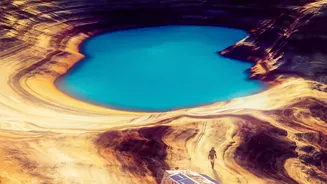
Titan is a world of incredible intrigue. It is the only moon in our solar system with a thick atmosphere, and the only celestial body besides Earth with stable liquid on its surface. But instead of water, Titan’s rivers, lakes, and seas are filled with liquid methane
and ethane. Its atmosphere is mostly nitrogen, like Earth's, but it's shrouded in a thick, organic haze. Beneath its water-ice crust, evidence suggests a vast liquid water ocean may exist. This combination of complex organic molecules and the potential for liquid water makes Titan a prime target for studying how the building blocks of life might form on other worlds.
Meet Dragonfly: The Flying Explorer
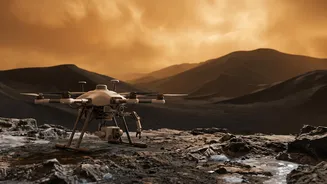
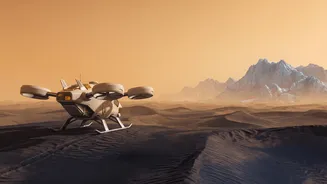
To explore this diverse and complex landscape, NASA is sending a revolutionary machine: Dragonfly. Scheduled to launch in July 2028 and arrive at Titan in 2034, Dragonfly is a dual-quadcopter, or octocopter, designed to fly from place to place. This is possible because of Titan’s unique environment; its atmosphere is four times denser than Earth’s and its gravity is much weaker, making flight an ideal mode of transport. Powered by a radioisotope power system, which converts heat from decaying plutonium into electricity, Dragonfly will be able to recharge its batteries and operate in the extreme cold, far from the Sun. This mobility will allow it to visit dozens of sites over its multi-year mission, covering far more ground than a traditional rover ever could.
Searching for the Recipe for Life
The primary goal of the Dragonfly mission is to investigate prebiotic chemistry. This means it will be searching for the complex organic molecules that could be steps on the path toward life. Titan's atmosphere is a massive chemical reactor, where sunlight and energetic particles break down methane and nitrogen, leading to the formation of more complex organic compounds that rain down onto the surface. Scientists believe Titan could be a snapshot of what early Earth was like before life emerged, preserving chemical processes that have long been erased on our own planet. Dragonfly is not looking for existing life, but rather for the ingredients and conditions that could make a world habitable.
Sampling an Alien Landscape
To achieve its goals, Dragonfly is equipped with a sophisticated suite of scientific instruments. It has drills to collect samples from the surface, which will then be fed into a mass spectrometer to analyze their chemical composition in detail. Cameras will provide high-resolution images of the terrain, both from the ground and the air, helping scientists scout for the next landing spot. It also carries a seismometer to detect “Titanquakes” and a suite of sensors to monitor the weather. The initial landing area is near Selk Crater, a site where scientists believe that a past impact may have melted water ice, allowing it to mix with the rich organic material on the surface. This makes it a compelling location to search for complex molecules formed in a transient, water-rich environment.