



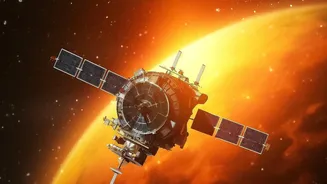

India's Unblinking Eye on the Sun
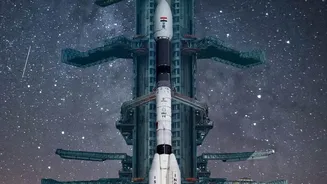
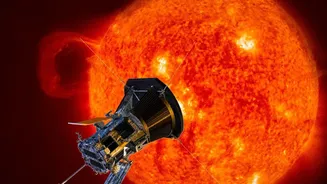
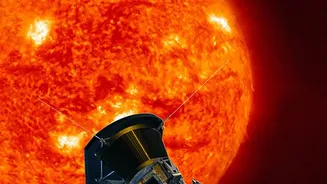
Launched in September 2023, Aditya L1 is India's first dedicated mission to study the Sun. From its unique vantage point 1.5 million kilometres from Earth, at a gravitationally stable location called Lagrange Point 1 (L1), the spacecraft has an uninterrupted
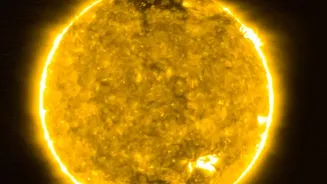
view of our star. This position allows its seven sophisticated payloads to continuously monitor solar activities without the interference of eclipses. The mission's primary goal is to understand the Sun's behaviour, from its blistering outer atmosphere, the corona, to the streams of charged particles it constantly emits, known as the solar wind. This data is fundamental to understanding space weather and its effects.
Decoding Violent Solar Eruptions
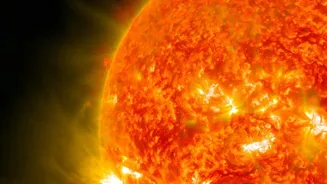
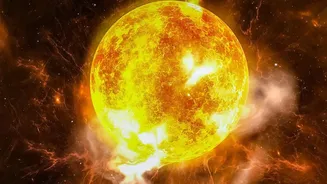
The Sun is not always the calm, life-giving star it appears to be. It frequently unleashes powerful explosions of energy and matter known as solar flares and Coronal Mass Ejections (CMEs). CMEs are massive eruptions of plasma and magnetic fields from the Sun's corona that travel through space. If one of these storms is aimed at Earth, it can trigger a geomagnetic storm, a major disturbance of our planet's magnetic field. These storms aren't just a curiosity for scientists; they can have severe real-world consequences, disrupting satellite operations, communication networks, GPS navigation, and even power grids on the ground.
The Latest Breakthrough Data
Recent observations from Aditya L1 have provided an unprecedented look into the nature of these solar storms. By studying a powerful CME, scientists at ISRO were able to gather crucial data on its characteristics. The instruments aboard the spacecraft identified a turbulent region within the solar storm that was responsible for the most severe effects. This turbulent zone strongly compressed Earth's magnetic shield, pushing it much closer to the planet and exposing some geostationary satellites to the harsh solar wind. The mission’s Visible Emission Line Coronagraph (VELC) captured spectroscopic data showing the immense energy of the CME plasma. This vital information helps scientists differentiate the storm's material from the surrounding solar corona and better understand its dynamics.
A Game-Changer for Space Weather Prediction
This new data is more than just an academic achievement; it's a game-changer for space weather forecasting. By combining Aditya L1's direct measurements of the solar wind with observations from ground-based networks, researchers can build more accurate models of how solar storms travel and how they will interact with Earth's magnetic field. Understanding the structure of CMEs, especially their turbulent sections, allows for better prediction of their arrival time and potential impact. These earlier and more accurate warnings give operators of critical infrastructure—from satellite companies to national power grids—the time they need to take protective measures, such as placing satellites into a safe mode to prevent damage.
Protecting Our Modern, Tech-Reliant World
In an age where our daily lives depend on technology, from digital payments to navigation apps, the threat of severe space weather is significant. A major geomagnetic storm could have cascading effects on our interconnected world. The data from Aditya L1 is a crucial part of a global effort to mitigate these risks. The mission's findings not only enhance our scientific understanding of the Sun-Earth connection but also provide practical tools to safeguard the vital assets we rely on. As India continues to expand its presence in space and its reliance on satellite technology, the role of Aditya L1 as a national sentinel becomes ever more important, solidifying India's position at the forefront of space science.