






The Problem on the Ground
The new lunar gold rush is focused on the Moon's south pole, where permanently shadowed regions (PSRs) are believed to hold vast quantities of water ice. This ice is a double prize: a priceless scientific record of the solar system and a critical resource
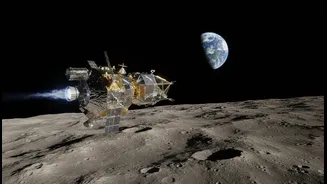
for future bases, providing water, air, and rocket fuel. However, a new wave of research shows that getting to this ice might ruin it. Recent studies have found that exhaust from a single lunar lander doesn't just settle nearby. In the Moon's near-vacuum, gases like methane and water vapor can spread globally in hours, contaminating the very ice deposits they are meant to study or use. This contamination could permanently alter the ancient ice, destroying billions of years of scientific data before it can even be analyzed.
A Traffic Jam at the Pole
This isn't a problem for just one mission. With NASA's Artemis program, an array of commercial landers via the CLPS program, and missions from China, India, and other nations all targeting the same polar regions, the Moon is about to get crowded. The exhaust plume from one landing could damage scientific instruments or contaminate a resource site kilometers away. This raises a fundamental question: if your lander's arrival can negatively impact my mission, who has the right of way? It transforms a technical engineering problem into a complex issue of resource management and international coordination, creating an urgent need for clear rules of the road on a world that has none.
The Scramble to Write the Lunar Rulebook
This is the bigger story. In response to this new era, the United States has championed the Artemis Accords, a set of non-binding principles for lunar exploration signed by dozens of countries. The Accords build on the 1967 Outer Space Treaty, attempting to translate its broad principles into practical guidelines. A key section focuses on the "deconfliction of activities," proposing the use of "safety zones" to prevent harmful interference between different missions. The idea is that nations or companies will provide public information about their operations, allowing others to coordinate and avoid conflict. This is the first major attempt to create a system of governance and traffic management for activities on another celestial body.
What Does 'Due Regard' Even Mean?
The debate centers on vague but crucial language in the Outer Space Treaty, which obligates nations to act with "due regard" for the interests of others. The Artemis Accords' concept of safety zones is an attempt to define what "due regard" looks like on the ground. However, these zones are highly controversial. Critics worry they could effectively become a form of national appropriation, allowing first-comers to claim the most valuable real estate, like ice-rich craters, in violation of the treaty's ban on property claims. The debate is fierce because the outcome will set a precedent for how humanity shares and utilizes resources beyond Earth. Defining the size and scope of a safety zone—and whether it's for scientific protection or commercial exclusion—is now a central challenge for space law and diplomacy.
From Scientific Record to Economic Asset
Ultimately, the tension between lander exhaust and lunar ice is a proxy for a much larger conflict: the dual nature of the Moon as both a scientific preserve and an economic frontier. Water ice is not just a subject for study; it's seen as the key to a self-sustaining lunar economy, drastically cutting the cost of space operations. Companies are already developing technologies for in-situ resource utilization (ISRU) to turn this ice and lunar regolith into valuable commodities. The rules being hammered out now—spurred by the tangible threat of contamination and interference—will determine how the balance is struck. They will decide whether the Moon's most valuable sites are treated as protected scientific laboratories, open-access commercial zones, or something in between.