



The 'Goldilocks Zone' Promise
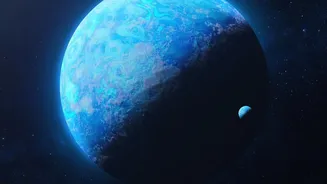
The concept of the habitable zone is simple and elegant. It describes the orbital band around a star where it's not too hot and not too cold for liquid water to exist on a planet's surface. Since water is essential for life as we know it, this zone has
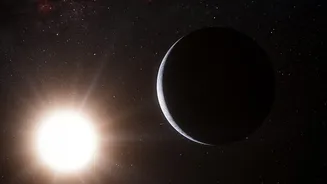
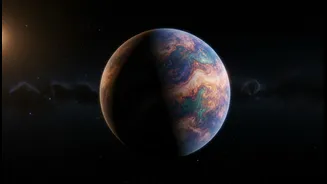
been the primary tool for astronomers to narrow down which of the thousands of known exoplanets might be worth a closer look. Most of the potentially habitable planets we've found orbit red dwarf stars. These stars are the most common in our galaxy, making up about 70-80% of the stellar population, and they have incredibly long lifespans, theoretically giving life trillions of years to emerge. Because red dwarfs are much cooler and dimmer than our Sun, their habitable zones are very close to the star, meaning planets must huddle near for warmth. And therein lies the problem.
A Star's Volatile Temper
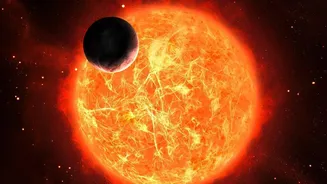
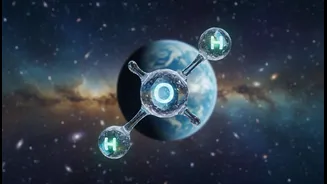
Red dwarfs are notorious for their violent tempers. They are known to unleash powerful stellar flares—immense bursts of radiation and charged particles—far more frequently and energetically than Sun-like stars. A planet orbiting in the close-in habitable zone of a red dwarf would be subjected to this harsh space weather constantly. These flares can be devastating, packing enough X-ray and ultraviolet radiation to strip a planet's atmosphere over time. Imagine Earth, but without its protective atmospheric blanket, exposed to the raw, unfiltered fury of its star. The process, known as atmospheric erosion or photoevaporation, would see high-energy radiation break down atmospheric molecules and blast them into space, taking with them the very ingredients for water, like hydrogen and oxygen.
More Than a Bad Sunburn
The consequences of frequent, powerful flaring go beyond just stripping away an atmosphere. The intense radiation could be fatal to any life trying to form on the surface. Studies suggest that for some planets orbiting flare stars, the radiation dose reaching the ground could reach fatal levels, even with an Earth-like atmosphere. If the atmosphere is thinner, which is likely after millions of years of being battered, the surface becomes even more dangerous. Furthermore, the constant gravitational pull from the nearby star can cause a planet to become tidally locked, with one side perpetually facing the star in unending daylight and the other frozen in permanent night. This creates extreme temperature differences that make habitability a challenge, even before accounting for radiation storms.
Is There a Shield?
Not all hope is lost. Just as Earth has a magnetic field that protects us from our Sun's solar wind and flares, a rocky exoplanet could have its own magnetosphere. A strong magnetic field could deflect many of the charged particles from a stellar flare, shielding the atmosphere from being blown away. However, the sheer intensity of red dwarf flares might overwhelm even an Earth-like magnetic shield. Another possibility is that life could survive underwater, with a global ocean providing a thick, protective layer against the radiation above. Interestingly, some recent research suggests a surprising twist: while flares are mostly destructive, the ultraviolet radiation they provide might be a necessary ingredient to kickstart the chemical reactions needed for life to begin. Low-mass stars don't typically emit enough UV radiation, so periodic flares could, in theory, help create a 'UV habitable zone' that overlaps with the liquid water zone.
A More Complicated Search
The realization that stellar activity is a crucial factor has refined the search for life. It's no longer just about a planet's location; it's about the stability of its entire system. Scientists are now expanding the definition of the habitable zone to include factors like stellar flares and a star's age. Even older red dwarfs, once thought to be settled down, have been observed to be surprisingly active, flaring about 25% of the time. This complex picture pushes astronomers to look not only at red dwarfs but also to continue searching for Earth-like planets around more stable, Sun-like stars (G-type) and slightly cooler K-type stars, which may offer a better balance of longevity and calm. The James Webb Space Telescope is at the forefront, analyzing exoplanet atmospheres in unprecedented detail to see which ones have survived the harshness of their stellar parents.