


An Eye That Never Blinks
Most Earth observation satellites circle the planet in a low orbit, seeing any given spot for only a few minutes each day. The GISAT series is different. It is designed for a geostationary orbit, a special position 36,000 kilometres above the equator.
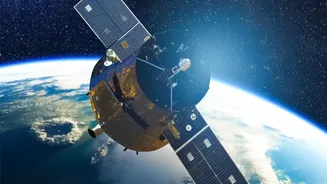
From here, a satellite's speed matches the Earth's rotation, making it appear stationary over a single point. This allows for continuous monitoring of a vast area—in this case, the entire Indian subcontinent. Instead of getting brief snapshots, ISRO can get a persistent, live view, which is a game-changer for tracking rapidly developing events like cyclones or floods.
A Mission of Redemption
The journey to this capability has been challenging. In August 2021, the first satellite in this series, GISAT-1 (also known as EOS-03), was lost during launch. The GSLV-F10 rocket carrying it suffered a technical anomaly in its cryogenic upper stage, which failed to ignite. An investigation later revealed the likely cause was a leaky valve that led to a drop in fuel tank pressure. The failure was a significant setback, leaving a critical gap in India's strategic observation capabilities. The upcoming GISAT-1A mission, also designated EOS-05, is ISRO's second attempt to fulfill this crucial objective.
What Makes GISAT-1A So Powerful?
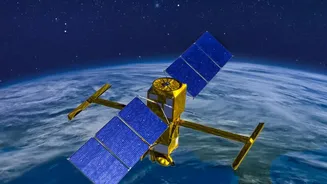
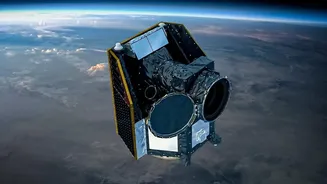
GISAT-1A is a state-of-the-art agile imaging satellite. Its onboard instruments are designed to capture high-resolution pictures across various spectral bands, including visible, near-infrared, and short-wave infrared. This allows it to see more than the human eye. According to ISRO's plans, it will be able to image the entire Indian landmass every 30 minutes with a spatial resolution of about 42 metres. Even more impressively, it can be steered to focus on a specific area of interest, capturing images of a high-priority target every five minutes. This rapid revisit capability is what makes it invaluable for real-time monitoring. The satellite is designed for a mission life of 10 years.
From Disaster Warnings to Border Security
The applications for this technology are vast and directly impact national well-being. For disaster management, the ability to track the path and intensity of a cyclone in near real-time can lead to more accurate warnings and timely evacuations. It can monitor floods as they unfold, spot forest fires the moment they start, and assess agricultural health over wide areas to predict crop yields. Beyond civilian uses, GISAT-1A offers a significant strategic advantage. A constant eye over the subcontinent provides an enhanced capability for monitoring border areas, tracking troop movements, and improving overall situational awareness for the country's defence and intelligence agencies.
The Launch and What's Next
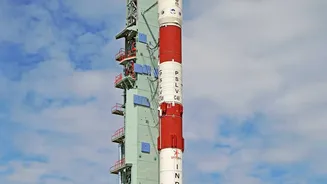
GISAT-1A is scheduled for launch in early September 2026 aboard a Geosynchronous Satellite Launch Vehicle (GSLV) Mk-II rocket from the Satish Dhawan Space Centre in Sriharikota. The rocket, designated GSLV-F17, will place the satellite into a temporary transfer orbit. From there, the satellite will use its own onboard propulsion system to perform a series of burns to climb to its final geostationary slot. The success of this mission is crucial for ISRO, not only to fill the capability gap left by the 2021 failure but also to reassert the reliability of its GSLV launch vehicle. It represents a key step in India’s ambition to achieve self-reliance in critical space technologies.