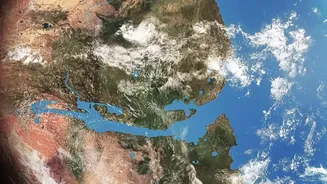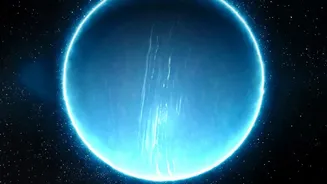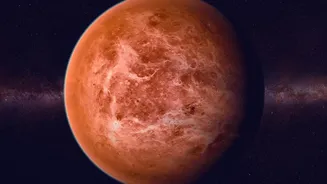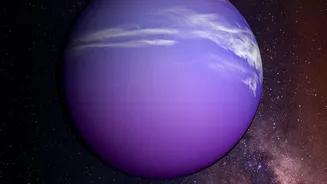



A Steamy 'Super-Earth' 97 Light-Years Away
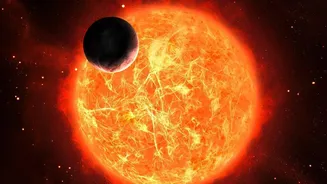
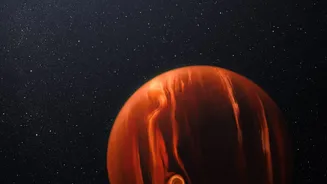
The planet in question, known as GJ 9827d, is located 97 light-years from Earth in the constellation Pisces. It is roughly twice the diameter of Earth, placing it in the category of a 'super-Earth'. While NASA's Hubble Space Telescope first found hints
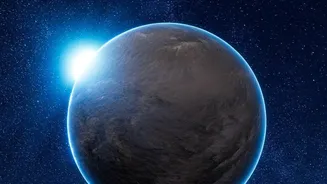
of water there, the unparalleled power of the James Webb Space Telescope (JWST) was needed to confirm and analyze its atmosphere in detail. The recent observations have confirmed that the planet's atmosphere is rich in water, leading some scientists to label it a 'steam world' or 'water world'. This makes it the smallest exoplanet to date with a confirmed water-rich atmosphere, a significant milestone in exoplanetary science.
How Webb Gazes Into Alien Atmospheres
Detecting what an exoplanet's atmosphere is made of from nearly 100 light-years away sounds like science fiction, but it's a technique called transmission spectroscopy. As GJ 9827d passes in front of its host star from our perspective, a tiny fraction of the starlight filters through the planet's atmosphere. Different molecules absorb light at specific wavelengths, leaving a unique chemical fingerprint on the light that reaches Webb's sensitive instruments. By analyzing this spectrum of light, astronomers can determine which gases are present. For GJ 9827d, the signature of water vapour was unmistakable, a testament to the JWST's incredible capabilities.
Habitable? Don't Pack Your Bags Yet
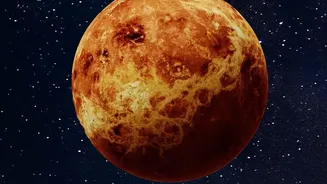
The presence of water immediately sparks questions about habitability. However, GJ 9827d is far from an Earth-like paradise. The planet orbits its red dwarf star very closely, completing a full year in just 6.2 Earth days. This proximity results in scorching surface temperatures, likely as hot as Venus at around 430 degrees Celsius. At this temperature, any water would exist as a thick, oppressive steam, creating a high-pressure greenhouse effect rather than life-sustaining liquid oceans. So, while the discovery is exciting, scientists are clear that this world is not hospitable to life as we know it.
A Landmark for Future Discoveries
So, if GJ 9827d isn't habitable, why is this such a big deal? The answer lies in what it proves. This discovery is a powerful demonstration that the Webb telescope can successfully detect and characterize the atmospheres of smaller, rocky-type planets. Previously, such detailed atmospheric detections were largely limited to massive gas giants. Being able to identify a water-rich atmosphere on a planet only twice the size of Earth is a huge technical leap forward. It opens the door to applying the same techniques to other, more promising rocky planets that might orbit their stars within the 'habitable zone'—the temperate region where liquid water could potentially exist on a planet's surface.