







Myth: India Quit the 1950 World Cup Over a Barefoot Ban
This is one of Indian football's most enduring and romanticised stories: that the national team, having qualified for the 1950 World Cup in Brazil, proudly withdrew after FIFA refused to let them play barefoot. It paints a picture of a team standing by
its principles. The reality, however, is far more complicated and less defiant. While Indian players had famously played barefoot in the 1948 Olympics, this was not the primary reason for their absence in Brazil. Historical records show the All India Football Federation (AIFF) had several concerns. The long journey by sea, inadequate preparation time, and internal disagreements about team selection were major factors. Furthermore, in the 1950s, the Olympic football tournament was considered more prestigious than the World Cup by many nations, including India. The AIFF prioritised the Olympics, and the World Cup was seen as a less important venture. The barefoot story was likely a convenient excuse that grew into a powerful myth over time.
Myth: The Original World Cup Trophy Was Found and Is Now Safe
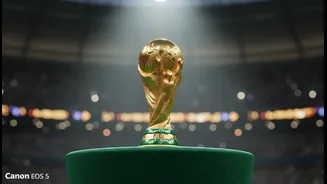
This myth is a half-truth that misses the story's tragic final chapter. The original trophy, the Jules Rimet Cup, was indeed stolen in London just before the 1966 tournament. A week later, in a moment that became English folklore, a dog named Pickles discovered the trophy wrapped in newspaper under a hedge in South London. But Pickles' discovery was only a temporary reprieve for the coveted prize. After Brazil won the tournament for the third time in 1970, they were given the trophy permanently, as per FIFA's rules at the time. It was put on display at the Brazilian Football Confederation headquarters in Rio de Janeiro. In 1983, it was stolen a second time. This time, there was no heroic dog to save the day. The trophy was never recovered, and it is widely believed that the thieves melted it down for its gold. The trophy currently on display is a replica.
Myth: Geoff Hurst's 1966 'Ghost Goal' Definitely Crossed the Line
For England fans, it’s the goal that secured their only World Cup. For German fans, it's the ultimate injustice. In the 1966 final, Geoff Hurst's shot in extra time struck the crossbar and bounced down. Azerbaijani linesman Tofiq Bahramov gave the goal, the referee agreed, and England went on to win 4-2. For decades, the debate has raged: did the whole of the ball cross the whole of the line? The myth, depending on your allegiance, is that it was either clearly in or clearly out. The truth is that it remains one of the most controversial and debated moments in football history. Even with modern analysis, there is no universally accepted conclusion. Some video reconstructions have suggested it did not fully cross the line, while others using different technology have claimed it did. The enduring ambiguity is precisely what makes the 'Wembley Goal' legendary.
Myth: The Host Nation Always Gets an Easy Ride
There's a persistent belief that host nations are guaranteed an easy draw and an unnaturally deep run in the tournament, thanks to home advantage and favourable conditions. While hosting is a significant advantage, it's far from a golden ticket. Six hosts have won the World Cup, but the last to do so was France in 1998. Many host nations have performed exceptionally, such as South Korea reaching the semi-finals in 2002. However, for every success story, there are hosts who have struggled. South Africa in 2010 became the first and only host nation to be eliminated in the group stage. Spain underperformed on home soil in 1982, and Qatar also failed to advance in 2022. The advantage of fan support, familiar climate, and less travel is real, but it doesn't suspend the brutal competitiveness of the World Cup. A good team can become great at home, but hosting doesn't automatically make a weaker team a contender.