


Cosmic Messengers from Stellar Explosions
Cosmic rays are subatomic particles, mostly protons and atomic nuclei, that constantly rain down on Earth from space. While we've known about them for over a century, their exact origins remained a long-standing mystery because their paths are scrambled
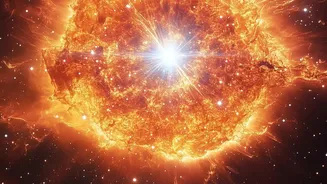
by galactic magnetic fields. However, strong evidence now points to supernova remnants—the expanding shells of gas and debris from stellar explosions—as the primary accelerators for a large portion of these particles. The idea, first proposed in the 1930s, is that the powerful shockwaves from a supernova can trap and accelerate particles, repeatedly boosting their energy until they escape and travel across the cosmos.
An Invisible Collision in the Sky
A major challenge in studying cosmic rays is that Earth’s atmosphere acts as a shield, preventing them from reaching the ground directly. So how do ground-based telescopes 'see' them? The answer lies in a clever indirect detection method. When a high-energy cosmic ray smashes into an air molecule in the upper atmosphere, it triggers a chain reaction. This collision creates a cascade of billions of secondary particles—electrons, positrons, and muons—that shower down through the atmosphere. This cascade is known as an extensive air shower. While the original cosmic ray is lost, this shower of secondary particles carries crucial information about its energy and direction.
Catching a Faint Blue Flash
The secret ingredient for detection is a phenomenon called Cherenkov radiation. As the particles in the air shower tear through the atmosphere, many of them are travelling faster than the local speed of light in air. This is like a sonic boom, but for light. These superluminal particles produce a very faint, brief flash of blueish-ultraviolet light, known as Cherenkov light. This flash, lasting only a few nanoseconds, travels in a cone shape and illuminates a large circular 'pool' of light on the ground, typically about 250 metres in diameter. This faint light is the signal that giant ground telescopes are built to detect.
Giants on the Ground
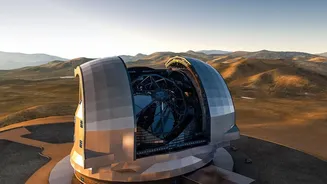
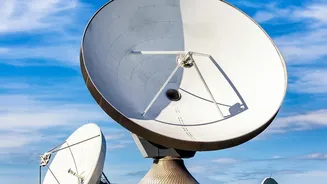
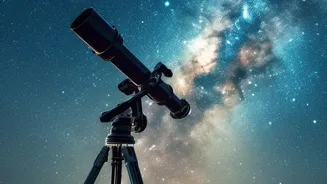
Observatories like the High Energy Stereoscopic System (H.E.S.S.) in Namibia, the Major Atmospheric Gamma-ray Imaging Cherenkov (MAGIC) telescopes in Spain, and VERITAS in the United States are not typical telescopes. They are arrays of very large mirrors designed to capture the faint Cherenkov flashes on moonless nights. These are known as Imaging Atmospheric Cherenkov Telescopes (IACTs). By using multiple telescopes in a stereoscopic system, scientists can view the same air shower from several angles. This allows them to precisely reconstruct the trajectory of the shower in 3D, pinpointing the original cosmic ray's arrival direction in the sky with incredible accuracy. In India, the GRAPES-3 experiment in Ooty uses a different method, employing a large array of scintillators and muon detectors to study the particle showers directly as they reach the surface, providing crucial data on cosmic rays and space weather.
Decoding the Cosmic Blueprint
Once a Cherenkov flash is detected, the work of analysis begins. The shape and orientation of the light pattern captured by the telescope's cameras can distinguish a shower started by a gamma-ray photon from one started by a cosmic-ray proton, allowing scientists to filter out background noise. The total brightness of the flash reveals the energy of the original cosmic ray, while the stereoscopic imaging points back to its source on the celestial sphere. By piecing together this information, astrophysicists can map high-energy sources in the sky, test theories of particle acceleration in supernova shockwaves, and gain a deeper understanding of the most violent and energetic processes shaping our universe. The next generation, the Cherenkov Telescope Array Observatory (CTAO), promises to be ten times more sensitive, opening an even wider window onto these extreme cosmic events.