

The final act of a star like our Sun has long been seen as a two-part cosmic play. But a new study suggests the drama for surrounding planets begins much earlier, rewriting the timeline for when planetary systems begin to fall apart.
A New Timeline for Cosmic Chaos
For decades, the prevailing
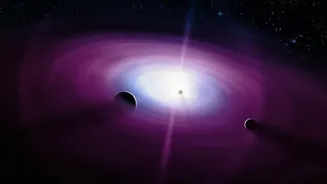
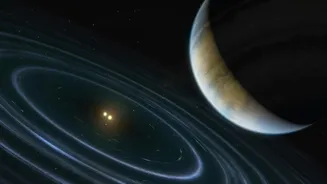
view of a solar system's end was that its outer planets would enjoy a long, stable existence long after their host star died. It was thought that even after a Sun-like star swelled into a red giant and then collapsed into a dense white dwarf, the giant planets would continue their stately orbits for billions, or even trillions, of years. A recent study, however, dramatically revises this picture. New simulations suggest that the orbital instability of giant planets like Jupiter and Saturn can begin much earlier—during the star's turbulent giant-branch phases, before it even becomes a white dwarf. This finding implies that the process of planetary system disintegration is not a quiet epilogue but a chaotic event that is contemporaneous with the star's death throes.
The Life and Death of a Sun-Like Star
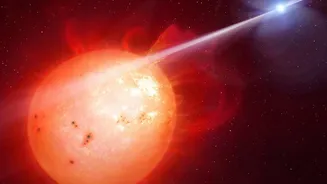
To understand the study's significance, it helps to review the life cycle of a star like our Sun. For billions of years, it fuses hydrogen into helium in its core. When that fuel runs out, the star's core contracts and its outer layers expand dramatically. It becomes a red giant, swelling to potentially engulf its inner planets. Following this phase, it enters the Asymptotic Giant Branch (AGB), a period characterized by high luminosity and significant mass loss through powerful stellar winds. This is the final stage before the star sheds its outer layers entirely, leaving behind its hot, dense core: a white dwarf. The previous understanding was that while the inner planets might be destroyed during the red giant phase, the outer planets' orbits would simply expand and stabilize as the star's gravitational pull weakened.
Not a Smooth Exit, But a Series of Kicks
The key insight from the new research lies in how the dying star loses mass. Instead of a smooth, continuous process like a slowly deflating balloon, the study models the mass loss as a series of thousands of discrete, asymmetric ejections. Think of it like a sputtering engine rather than a steady exhaust. Each of these ejections gives the star a tiny 'kick' or recoil. While a single kick is small, the cumulative effect of thousands of random kicks from different directions perturbs the star's position. From the perspective of the orbiting planets, this is like having the gravitational anchor at the center of their orbits constantly and randomly jostled. This 'random walk' destabilizes the delicate gravitational balance of the whole system.
From Stability to Billiards
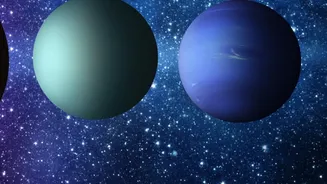
The simulations, run hundreds of times with these 'kicky' mass-loss models, produced startling results. In a significant number of cases, the outer planetary system became unstable during the star's giant-branch evolution or within a few billion years after it became a white dwarf—far sooner than the tens of billions or even quintillions of years previously estimated. The instability could manifest in dramatic ways. In some simulations, planets were thrown out of the solar system entirely. In others, planets like Uranus and Neptune exchanged orbits, or their orbits became wildly eccentric and inclined. The once-orderly clockwork of the solar system devolved into a chaotic game of cosmic billiards, and this process started before the star had even fully died.
What This Means for Our Solar System
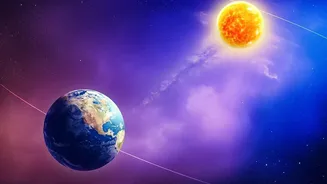
This research provides a fascinating, if sobering, glimpse into the potential long-term future of our own home. In about five billion years, our Sun will begin its transformation into a red giant. The inner planets, including Earth, are likely to be engulfed and destroyed. For a long time, it was assumed the giant planets—Jupiter, Saturn, Uranus, and Neptune—would survive on expanded but stable orbits. This new study suggests their fate may be far more violent and unpredictable. The 'stochastic' or random mass loss from the dying Sun could trigger instability that scatters them across the galaxy or sends them careening into new, chaotic arrangements. While this is a destiny billions of years away, it fundamentally changes our understanding of how planetary systems evolve and, ultimately, end.