



Cosmic Detectives in the Stratosphere
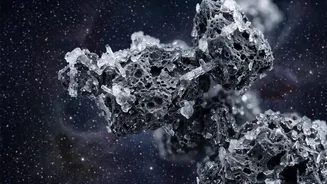
Sending a probe to the Kuiper Belt to collect samples and return them is currently beyond our technological reach. So how do scientists study this remote region? The answer lies in collecting its dust right here at home. For years, NASA has used high-altitude
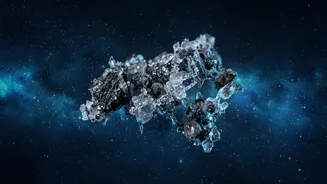
aircraft to fly through Earth’s stratosphere, collecting tiny interplanetary dust particles (IDPs) that have journeyed across the solar system. A team led by planetary scientist Lindsay Keller of NASA's Johnson Space Center recently analyzed 12 of these microscopic grains and made a startling discovery. By examining the 'scars' left by solar particles, they could determine how long the dust had been travelling. The high density of these tracks suggested the grains came not from the nearby asteroid belt, but from the far-flung Kuiper Belt, making them invaluable messengers from the solar system's outer rim.
Fingerprints of 'Heavy' Water
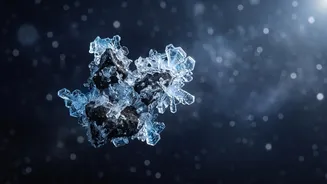
Within these dust particles, the researchers found hydrated minerals like saponite and serpentine. These minerals can only form when rock interacts with liquid water, which implies that billions of years ago, the interiors of the icy Kuiper Belt objects these dust grains came from were warm enough to melt ice. While that water is long gone, its chemical signature remains locked in the minerals. The key finding came from an analysis of oxygen isotopes—different versions of the oxygen atom. The water that formed these minerals was unusually rich in 'heavy' oxygen isotopes (oxygen-17 and oxygen-18). This specific isotopic fingerprint is different from water found in meteorites that originated closer to the sun, pointing to a distinct and separate source.
A Pristine Primordial Reservoir
This discovery provides compelling evidence for a theory scientists have long held: that the outer solar system contains a massive reservoir of water that was chemically different from the water in the inner solar system. This Kuiper Belt reservoir appears to have been largely isolated, protected from the mixing and chemical changes that occurred closer to the sun during the solar system's chaotic formation. The giant planets, particularly Jupiter and Saturn, may have acted as a barrier, preventing material from the inner and outer regions from blending. As a result, this 'heavy' water represents a pristine sample of the materials that were present in the outer solar nebula some 4.5 billion years ago.
Rethinking the Origin of Earth's Oceans
For decades, scientists have worked to uncover the source of Earth's oceans. The leading theories suggest water was delivered to our young, dry planet by asteroids and comets. This new finding complicates that picture in a fascinating way. By identifying a separate, isotopically distinct water reservoir in the Kuiper Belt, it reinforces the idea that not all water in the early solar system was the same. While the water in this distant reservoir is different from Earth's, studying its composition helps scientists build more accurate models of planetary formation. Understanding the distribution and types of water across the primordial solar system is crucial to piecing together the complex delivery process that ultimately allowed life to flourish on our own world. The study of these tiny dust grains is a monumental step in that direction.