







The Orbital Junkyard
Imagine a highway with no rules, where abandoned cars travel at over 28,000 kilometres per hour. That’s the reality in low-Earth orbit. For decades, every rocket launch and satellite deployment has left something behind. According to NASA, there are now
more than 27,000 pieces of orbital debris larger than a softball being tracked. These include entire defunct satellites, spent rocket stages, and fragments from past collisions. The primary danger is not just to new launches but to the active satellites that power our modern world, from GPS and weather forecasting to global communications. A collision with even a small piece of debris can be catastrophic, creating thousands more pieces of junk and threatening a chain reaction known as the Kessler Syndrome, which could render entire orbits unusable.
An Invisible Tow Rope
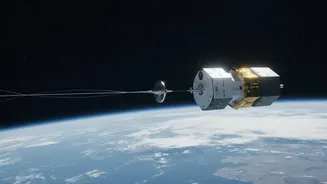
Cleaning up this mess is one of the biggest challenges in space engineering. How do you grab an object that is tumbling uncontrollably and was never designed to be captured? Trying to physically grab it with a robotic arm is incredibly risky and could create even more debris. This is where magnetic tethers come in. Instead of physical contact, this method uses powerful magnetic fields to influence a target satellite from a distance. A 'chaser' spacecraft would approach a piece of debris and generate a strong, rotating magnetic field. This offers a way to safely capture and deorbit a target without ever touching it, significantly reducing the risk of a disastrous collision during the operation.
The Science of Eddy Currents
The magic behind this contactless capture lies in a principle called eddy currents. Most satellites are not magnetic themselves, but they are typically built with conductive materials like aluminium alloys. When the chaser spacecraft projects a changing magnetic field onto the non-responsive satellite, it induces small, swirling electrical currents within the satellite's conductive body—these are the eddy currents. These currents, in turn, generate their own weak magnetic field. The interaction between the chaser's field and the new field created on the debris allows the chaser to exert a force and torque. By carefully controlling its own magnetic field, the chaser can first slow the target's wild spinning and then gently pull or 'tether' it, all without physical contact.
Pioneers in Orbital Cleaning
Several organizations and companies are at the forefront of this technology. The Japanese company Astroscale has been a notable pioneer with its ELSA (End-of-Life Services by Astroscale) missions. Their approach has focused on a docking plate that future satellites could be equipped with, allowing for a straightforward magnetic capture at the end of their life. Their ELSA-d mission successfully demonstrated the ability to capture and release a client satellite using a magnetic system. Other research, including work from the University of Utah, has advanced the theory of using coordinated electromagnets to achieve full six-degree-of-freedom control over an object, essentially allowing for precise, dexterous manipulation from a distance. NASA has also explored magnetic docking systems to assist in servicing and maintaining satellites.
Future-Proofing Space
The development of magnetic tethers is more than just a cleanup mission; it's about creating a sustainable future for space operations. As tens of thousands of new satellites are planned for launch in the coming years, primarily for large internet constellations, the need for effective end-of-life solutions is critical. By making it easier and safer to remove defunct satellites, these technologies ensure that valuable orbital paths remain clear and usable for future generations. This capability is foundational for the burgeoning in-orbit servicing industry, which aims to refuel, repair, and upgrade satellites, extending their operational lives and maximizing their value. Ultimately, a cleaner orbit is a safer and more economically viable one for everyone.