




A Glimpse Into a Potentially Watery World
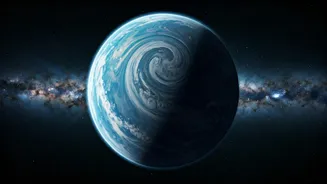
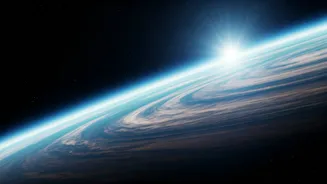
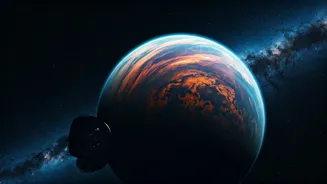
Recent observations have zeroed in on K2-18 b, an exoplanet about 120 light-years away that is more than eight times the mass of Earth. What makes this 'sub-Neptune' so compelling is that it orbits within its star's habitable zone—the region where temperatures
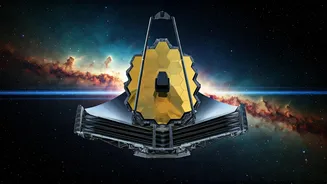
could be just right for liquid water to exist. Using its powerful instruments, the JWST has detected the definitive presence of carbon-bearing molecules, including methane and carbon dioxide, in K2-18 b's atmosphere. This discovery has bolstered a fascinating hypothesis: that K2-18 b could be a 'Hycean' world, a theoretical class of planet covered in a deep, globe-spanning ocean beneath a hydrogen-rich atmosphere. While not proof, it's a tantalizing piece of the puzzle.
How to Read an Atmosphere from 120 Light-Years Away
Detecting these chemical signatures from such an immense distance is a marvel of modern science. The technique is called transmission spectroscopy. Imagine watching a tiny moth fly in front of a bright streetlight. As it passes, the light dims slightly. Now imagine that moth has a thin, translucent layer around it. As the streetlight shines through this layer, some colours of light are absorbed, depending on what the layer is made of. The JWST does something similar. As an exoplanet like K2-18 b transits, or passes in front of its host star, the telescope precisely measures the starlight that filters through the planet’s atmospheric fringe. Different molecules—water, methane, carbon dioxide—block very specific wavelengths of infrared light, creating a unique chemical barcode that Webb is expertly designed to read.
Water Vapour: A Common, Crucial Ingredient
The discovery of carbon-based molecules is exciting, but the ultimate prize in the search for habitable worlds is often considered to be water. The JWST has been remarkably successful on this front, detecting signs of water vapour in the atmospheres of numerous exoplanets, from hot gas giants like WASP-96b to other sub-Neptunes like GJ 1214 b. The latter was shrouded in a thick haze that stumped previous telescopes, but Webb's ability to see in mid-infrared light allowed it to pierce the veil and find evidence of water. Finding water vapour confirms that one of life’s most essential building blocks is present. However, scientists are quick to note that water vapour in a hot atmosphere is very different from a liquid ocean on a temperate surface. It's a crucial first step, but not the destination itself.
The Hunt for 'Biosignatures'
The true holy grail is the detection of 'biosignatures'—molecules or combinations of molecules that strongly suggest the presence of life. On Earth, for example, the large amount of oxygen in our atmosphere is constantly replenished by living things. One of the most electrifying aspects of the K2-18 b observations was the possible, though not yet confirmed, detection of a molecule called dimethyl sulfide (DMS). On our planet, DMS is overwhelmingly produced by life, particularly marine phytoplankton. Finding it alongside methane and CO2 on a potential ocean world would be a monumental discovery. Scientists remain extremely cautious, as there could be unknown geological or chemical processes that produce DMS on such a different type of world. Further observations are already planned to verify this hint.
So, Are Alien Oceans Closer?
The headline's question hangs in the air: are we closer to finding alien oceans? The answer is a resounding, if measured, yes. We haven't directly imaged an ocean on a distant world yet, but for the first time, we are confirming that the necessary ingredients for such oceans exist on planets located in the right place. The James Webb Space Telescope is transforming the search for extraterrestrial life from a theoretical exercise into an observational science. It's giving us a planetary chemical inventory, showing us which worlds have water, which have carbon, and which might have the kind of atmospheric disequilibrium that could point to life. Each discovery is another dot on the map, guiding us toward the most promising targets in our cosmic neighbourhood.