




What Is This 'Blaze Star' Event?
The star at the centre of this cosmic excitement is T Coronae Borealis (T CrB), located about 3,000 light-years away in the constellation Corona Borealis, or the 'Northern Crown.' It’s not a single star, but a binary system where two stars are locked
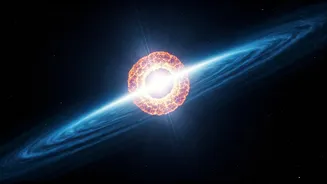
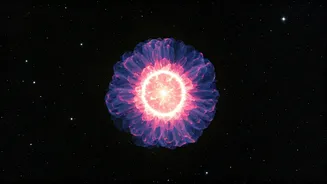
in a dramatic cosmic dance. One is a cool, aging red giant, and the other is a small, incredibly dense dead star called a white dwarf. T CrB is what astronomers call a recurring nova. Unlike a supernova, which is a catastrophic explosion that destroys a star, a nova is a temporary, brilliant flare-up on a star's surface. The 'recurring' part means it happens again and again, and for T CrB, the cycle is roughly every 80 years. The last time it put on a show for Earth was in 1946, making this year's event a true generational spectacle.
The Science Behind the Explosion
Imagine a cosmic pressure cooker reaching its limit. The white dwarf in the T CrB system is a gravitational bully. Its immense density constantly pulls, or 'accretes,' material—mostly hydrogen—from its larger red giant companion. This hydrogen piles up on the white dwarf's surface, getting hotter and denser over decades. Eventually, the pressure and temperature reach a critical point, triggering a runaway thermonuclear reaction. This isn't a deep, star-destroying explosion but a massive, violent burst on the surface. The result is a sudden and spectacular increase in brightness, which we observe from Earth as the nova. The system itself survives the outburst, and the whole process of the white dwarf siphoning fuel from the red giant begins all over again, setting the stage for the next eruption in another 80 years or so.
When and Where to Look
Pinpointing the exact moment is tricky, but NASA and other astronomy experts predict the eruption will occur sometime between now and September 2024. The signal will be unmistakable: a 'new' star will suddenly appear in the sky. Normally, T CrB is far too dim to see without a powerful telescope. But during the nova event, its brightness will surge to a magnitude of +2. This is comparable to Polaris, the North Star, making it easily visible to the naked eye, even from moderately light-polluted areas. You'll be looking for the constellation Corona Borealis, a small, C-shaped arc of stars located between the larger constellations of Boötes and Hercules. The nova will appear as a bright, temporary addition to this celestial crown.
A Guide to Spotting It from India
The Northern Crown is visible from India, making this a fantastic opportunity for local sky-watchers. For the best chance of spotting it, you’ll want to look towards the northern and northeastern sky during the late evening and post-midnight hours. The constellation rises in the evening and will be high in the sky through the night. To easily locate it, you can use stargazing apps on your phone like Star Walk, SkyView, or Stellarium. Simply search for 'Corona Borealis,' and the app will guide you. While the nova should be bright enough to see from a city balcony, heading to a darker location away from city lights will make the experience much more dramatic. You won't need a telescope or binoculars to see the nova itself, but they will certainly enhance the view, revealing the star's brilliance against the backdrop of its fainter neighbours.
A Truly Rare Cosmic Moment
Events like this are a powerful reminder of the dynamic and ever-changing universe we live in. There are only a handful of known recurring novae, and T CrB is one of the brightest and most reliable. Seeing it flare up is like witnessing a celestial appointment kept across generations. For most of us, this will be the only chance in our lifetime to see this particular star erupt. It’s an opportunity not just for seasoned astronomers but for anyone—families, students, and the simply curious—to look up and connect with the cosmos. It’s a shared, global event that costs nothing to witness but offers a profound sense of wonder.