






What is an Opposition?
In simple terms, an astronomical opposition happens when Earth passes directly between the Sun and an outer planet, like Saturn. Imagine the three bodies forming a straight line: Sun-Earth-Saturn. This alignment means a few things for viewers on Earth.
First, Saturn is at its closest point to our planet for the year, making it appear larger and more detailed through a telescope. Second, its face is fully illuminated by the Sun, causing it to shine at its maximum brightness. For observers in India, this means Saturn rose in the east around sunset on October 4 and remained visible throughout the night, setting in the west around sunrise the next morning.
The Special Brilliance of the Rings
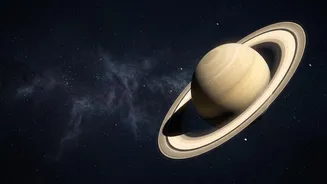
While the planet itself is brighter, the real star of the show during opposition is Saturn's magnificent ring system. The rings are made of countless icy particles that, at most times, cast tiny shadows on one another. However, for a few days around opposition, the Sun is almost directly behind us from Saturn's perspective. This unique angle means we can't see the shadows; they fall behind the particles. The result is a surge in brightness known as the 'Seeliger effect', which makes the rings appear exceptionally radiant compared to the planet's cloudy surface. This year's opposition is also special because the rings are becoming more visible again after appearing nearly edge-on and almost invisible in 2025.
How to Find Saturn
You don't need to be an expert to locate Saturn. It is bright enough to be seen with the naked eye, even from cities, though a darker sky provides a better experience. For viewers in India, look to the eastern sky after sunset. The planet will appear as a bright, steady, yellowish point of light. Unlike stars, which twinkle, planets tend to shine with a more constant glow. This month, Saturn is in the constellation Cetus, the Whale, near the Great Square of Pegasus. While the peak of opposition was October 4, the planet will remain an excellent target for viewing throughout the rest of October.
Naked Eye, Binoculars, or Telescope?
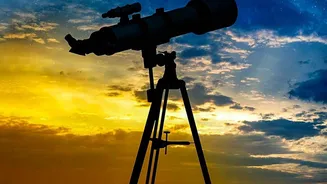
What you can see depends entirely on your equipment. With the naked eye, Saturn is a bright, star-like object. A good pair of binoculars might reveal that the point of light is not perfectly round, but slightly oval—your first hint of the rings. To truly appreciate the view, however, a telescope is needed. Even a small, 2-inch telescope with 25x magnification can reveal that the planet has rings. A larger, 6-inch telescope will provide a much clearer image, potentially showing the dark gap in the rings known as the Cassini Division, especially on a night with steady air. With a powerful enough instrument, you might even spot Saturn's largest moon, Titan, appearing as a tiny star-like dot nearby.
Tips for the Best View
To make the most of your stargazing session, find a location away from the direct glare of city and street lights. Give your eyes about 15-20 minutes to fully adjust to the darkness. When observing through a telescope, it's best to wait until Saturn has climbed higher in the sky, away from the turbulent air near the horizon, for a sharper image. If you are using a telescope, let it cool down to the outside temperature to prevent distorted views. And most importantly, be patient. The best views often come in moments of still air. While opposition provides the brightest view, the weeks following are still an ideal time to admire the solar system's ringed jewel.