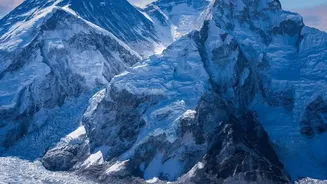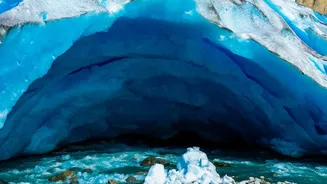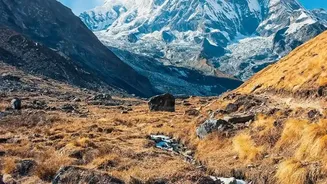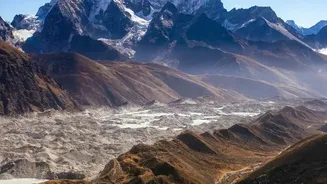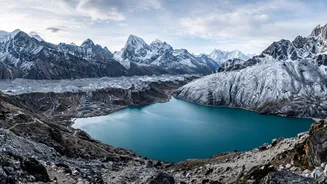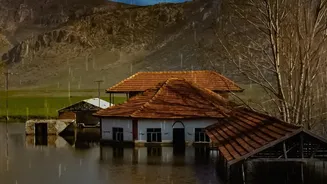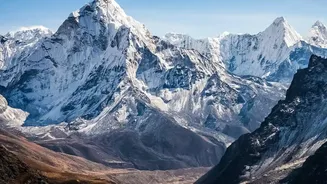




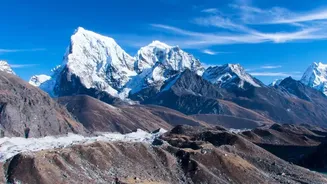
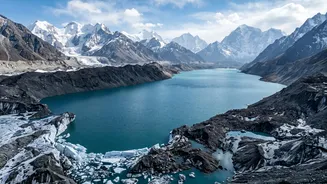
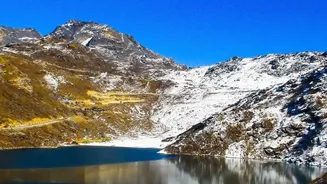
High in the Himalayas, thousands of 'ticking time bombs' are forming. New and expanding glacial lakes, swollen by climate change, pose a terrifying threat. UN reports now warn that these lakes could burst, endangering millions of lives and critical Indian
infrastructure.
What is a Glacial Lake Outburst Flood?
A Glacial Lake Outburst Flood, or GLOF, is a sudden and catastrophic release of water from a lake dammed by glacial ice or a moraine—a natural barrier of rock, sediment, and ice left behind by a retreating glacier. As global temperatures rise, glaciers are melting at an accelerated rate, feeding more water into these lakes. The natural dams holding this water are often unstable. They can be breached by a variety of triggers, including avalanches of rock or ice crashing into the lake, extreme rainfall, or simply the mounting pressure of the water itself. When the dam fails, a massive volume of water, mud, and boulders can surge down narrow mountain valleys at incredible speeds, destroying everything in its path.
The Himalayan Hotspot
The Hindu Kush Himalaya region is warming much faster than the global average, making it a hotspot for GLOF risks. Glaciers here have lost a significant amount of ice in recent decades, leading to the formation of thousands of new glacial lakes. In the Indian Himalayas alone, studies have documented the rapid expansion of existing lakes and the formation of dozens of new ones. For example, a recent study of the Alaknanda Basin found that the total area of glacial lakes grew by 67% in just 30 years. According to UN-backed reports, over 200 glacial lakes in the greater Himalayan region are already classified as potentially dangerous. The frequency of these disaster events is increasing, with GLOFs now occurring nearly five times more often than before 1950.
A Clear and Present Danger to India
A recent UN-affiliated study highlights India's extreme vulnerability, noting that between 1835 and 2025, India recorded the highest number of deaths from GLOFs among eight Himalayan countries, with over 6,000 fatalities. Past events serve as a grim reminder of the destructive power of these floods. The 2013 Kedarnath tragedy, triggered by the collapse of the Chorabari glacial lake after extreme rainfall, killed thousands of pilgrims and residents. More recently, the October 2023 bursting of the South Lhonak lake in Sikkim unleashed a devastating flood down the Teesta river, wiping out a major hydropower dam and causing significant loss of life. Authorities in states like Uttarakhand have identified multiple high-risk glacial lakes, some located near important pilgrimage sites, that pose a severe threat to downstream communities and infrastructure.
Critical Infrastructure on the Frontline
The development push in the fragile Himalayan region has placed billions of rupees worth of infrastructure directly in the path of potential GLOFs. Hydropower projects, crucial for India's energy security, are particularly at risk. The 2023 Sikkim flood obliterated the 1,200 MW Teesta-III dam, a multi-billion rupee project. Across the Himalayas, research shows that over 100 hydropower plants and thousands of kilometers of roads are threatened. These floods don't just destroy power stations; they sever vital transport links, wash away bridges, and demolish entire settlements, isolating communities for extended periods. With India planning further hydropower development in the region, the economic and human stakes are enormous.
A Race Against Time for Solutions
Addressing the GLOF threat requires a twopronged approach. Globally , experts stress the urgent need to cut greenhouse gas emissions to slow glacial melt . Locally , the focus is on adaptation and mitigation . This includes establishing robust early warning systems with sensors to monitor lake water levels and slope stability . In some cases , engineering solutions like controlled draining of dangerous lakes can reduce the immediate risk . However , a critical gap remains in transboundary cooperation for monitoring lakes that sit across international borders . Experts also call for a reevaluation of infrastructure planning in the Himalayas , steering critical projects away from highrisk flood paths to avoid future catastrophes .