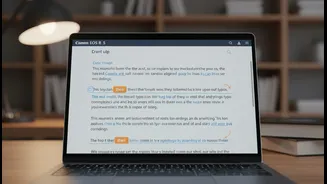








What Are AI Draft Reviewers?
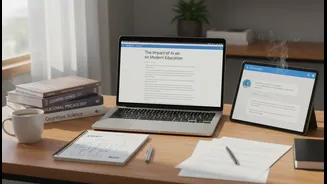
Beyond now-famous chatbots like ChatGPT, a more specialized category of AI is making its way into the study routines of students. These are AI draft review and academic writing tools, such as Paperpal, Grammarly's AI features, and QuillBot. Unlike generative
AIs that create content from scratch, these tools are designed to act as sophisticated assistants for a student's own work. They go far beyond simple grammar and spell-checking, offering to refine sentence structure, improve clarity, and ensure a consistent academic tone. For students juggling dense source material and the high stakes of a final paper, these tools promise to streamline the writing process, providing instant feedback that was once only available from a teacher or peer reviewer.
The Allure of an AI Assistant
The reasons for this growing adoption are clear. Students, particularly those tackling complex subjects or writing in a non-native language, find these tools invaluable. A study of university students highlighted that AI helps them organize ideas, understand difficult topics, and improve the communication of their own thoughts. For many, the primary appeal is efficiency and confidence. AI can help break down convoluted academic articles into digestible summaries, making the research phase less daunting. It can also assist in rephrasing sentences to sound more professional or academic, a feature especially useful for English-language learners navigating the nuances of scholarly writing. This support allows students to spend less time bogged down by mechanical errors and more time focusing on their core arguments.
Beyond Grammar and Spellcheck
Modern AI writing assistants offer a suite of advanced features tailored for academic work. Tools can suggest ways to strengthen an argument, ensure a paper's structure is logical, and even check for an appropriate academic tone. Some platforms can help generate outlines from rough notes or check citations for formatting errors. For instance, a student might use AI to check for coherence between their thesis statement and concluding paragraphs or to reduce wordiness in a dense section. The goal is to elevate the quality of the writing, making it more polished and persuasive. This level of support can be particularly helpful during the revision process, offering a fresh perspective on a draft a student has read numerous times.
The Fine Line to Plagiarism
The rise of these tools inevitably brings up serious ethical questions, chief among them: when does assistance become cheating? Most universities are scrambling to create clear policies, but the consensus is that using AI to generate entire essays or passing off AI-generated text as one's own work constitutes academic misconduct. Over-relying on paraphrasing tools without properly citing the original source is also considered plagiarism, as the core idea is not the student's own. Many universities now state that while tools for grammar checks are acceptable, students should not accept AI-generated 'improvements' that significantly alter their original work to the point where it's no longer in their own voice. The key distinction is whether the tool is supporting the student's thinking or replacing it entirely.
Are We Outsourcing Critical Thinking?
Educators and researchers voice a valid concern: if students lean too heavily on AI, they may not develop essential critical thinking and writing skills. The process of struggling with language, structuring an argument, and refining ideas is fundamental to learning. Some studies suggest that overreliance on AI tools can lead to a more superficial understanding of topics and a decline in analytical reasoning. If an AI is always there to smooth out a clunky sentence or organize a messy outline, students may miss the opportunity to learn how to do it themselves. The challenge for educators is to teach students how to use these tools responsibly, as a supplement to their intellect, not a substitute for it.