





The Real Enemy of Stargazers
The single biggest obstacle for most amateur astronomers isn’t the quality of their telescope; it’s the quality of their sky. Light pollution, the pervasive glow that blankets our towns and cities, is the true villain. This artificial skyglow, a result
of poorly shielded streetlights, commercial lighting, and residential fixtures, bounces around in the atmosphere, creating a luminous veil that obscures all but the brightest celestial objects. More than 80% of the world's population lives under light-polluted skies, effectively hiding the Milky Way from view for a huge portion of humanity. This bright background drastically reduces the contrast between faint deep-sky objects and the sky itself, making them difficult or impossible to see. Think of it like trying to hear a whisper in a crowded, noisy room; the message simply gets lost in the background chatter.
The Magnification Misconception
It’s a common belief that a more powerful telescope, one with higher magnification, is the key to seeing more. While magnification is useful for observing bright objects with fine detail, like the Moon or planets, it has a surprising downside when it comes to faint, fuzzy targets like galaxies and nebulae. Magnification doesn’t just enlarge the object; it enlarges the patch of sky around it, including the light-polluted skyglow. This spreads the object's limited light over a larger area, making its surface brightness even lower and harder to detect. Essentially, by cranking up the power in a light-polluted area, you are often just magnifying a blank, glowing patch of sky, making the object you want to see even more invisible. In many cases, lower magnification can actually provide a better, more pleasing view by concentrating the object's light and providing a wider context.
The Power of Darkness
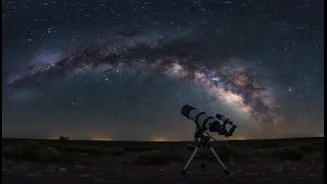
This is where the magic of a dark location comes in. When you escape the dome of city lights, the sky's background brightness plummets. This is quantified by the Bortle Scale, a nine-level system that measures sky darkness. A typical city center might be a Class 8 or 9, where only a few hundred stars are visible. In contrast, a Class 1 or 2 site, often found in remote parks, is a pristine dark sky where the Milky Way can be so bright it casts faint shadows. Under these conditions, the universe transforms. Faint objects that were completely invisible from the city, like the Andromeda Galaxy, can become obvious naked-eye targets. Through a telescope, the change is staggering. Diffuse nebulae reveal intricate structures, and distant galaxies show hints of spiral arms, details utterly washed out by even moderate light pollution. The difference isn't the telescope; it's the profound increase in contrast that only a dark sky can provide.
How to Find Your Window to the Universe
You don’t necessarily need to travel to a remote desert to experience this. For many people, a significant improvement in viewing quality is just a short drive away. Start by using an online light pollution map to identify darker areas near your home. You might be surprised to find that a 30- to 60-minute drive can take you from a Bortle Class 7 sky to a Class 4, where the Milky Way becomes easily visible. Look for state parks, national forests, or conservation areas, which often have lower levels of local light pollution. These designated 'Dark Sky Parks' and 'Reserves' are certified locations that actively work to minimize light pollution, offering not just great views but also educational programs. Even without a designated park, simply getting away from the direct glow of a city can make an astonishing difference. Check with local astronomy clubs, which often have established observing sites in good locations.