


Hunting for Planetary Shadows
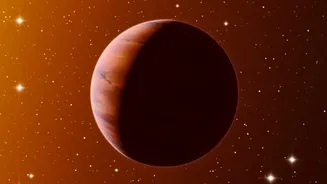
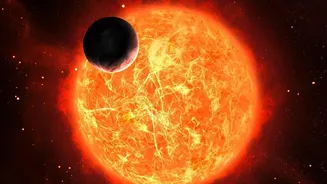
To understand how the JWST finds water, we first need to know how it finds planets and their atmospheres. Many exoplanets are detected using the 'transit' method. This occurs when a planet passes directly between its star and the telescope. As the planet transits,
it blocks a tiny fraction of the starlight, causing a minuscule, temporary dip in the star's brightness. This dimming not only reveals the planet's existence and size but also presents a golden opportunity. For a brief moment, the starlight filters through the outer edges of the planet's atmosphere, if it has one. It's within this sliver of light that the secrets of a world hundreds of light-years away are hiding.
Decoding Atmospheric Fingerprints
The core technique used by astronomers is called transmission spectroscopy. Think of it like this: pure starlight is a full spectrum of colours, like a rainbow. When this light passes through a planet's atmosphere, molecules within that atmosphere absorb very specific colours, or wavelengths, of light. Each molecule—water vapour, methane, carbon dioxide—has a unique absorption pattern, a sort of chemical 'fingerprint'. When the light finally reaches the JWST's detectors, it arrives with certain colours missing. By analysing this altered light and identifying which specific wavelengths have been absorbed, scientists can determine the chemical composition of the planet's atmosphere.
Seeing the Invisible with Infrared
This is where the 'infrared' in JWST's mission becomes critical. While our eyes see visible light, many of the most interesting molecular fingerprints, including that of water, are most prominent in the infrared part of the spectrum. The JWST is specifically designed to be exceptionally sensitive to this invisible light. Observing in infrared allows the telescope to do two things. First, it can peer through the vast clouds of cosmic dust that might otherwise obscure a star and its planets. Second, and more importantly for this task, the characteristic signals of key molecules are much stronger and more distinct in infrared light, making them easier to detect and measure with precision.
The Telescope’s Super-Sensing Tools
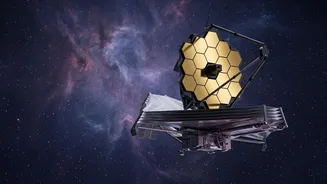
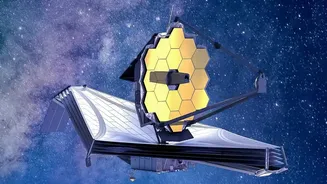
The JWST is equipped with a suite of highly advanced instruments, but two are particularly vital for this work: the Near-Infrared Spectrograph (NIRSpec) and the Mid-Infrared Instrument (MIRI). A spectrograph is a device that splits light into its constituent wavelengths, creating the very spectrum that scientists need to analyse. NIRSpec is designed to capture high-resolution spectra from over 100 objects simultaneously, but for exoplanets, it focuses on a single star to capture the faint signals filtered through a planet's air. MIRI observes at even longer infrared wavelengths, allowing it to detect a different range of molecular signatures and measure the planet's temperature. By combining data from these instruments, astronomers get a more complete and robust picture of an exoplanet's atmospheric makeup.
Challenges in the Cosmic Search
Detecting these signals is incredibly difficult, especially for rocky planets, which have much thinner atmospheres than gas giants. The signals are faint and can sometimes be confusing. For instance, astronomers studying the rocky exoplanet GJ 486 b detected signs of water vapour with NIRSpec. However, they had to consider whether the signal was from a planetary atmosphere or from water vapour in cool spots on the star itself. Later observations with MIRI suggested the planet likely has little to no atmosphere, and the water signature originated from the star. This illustrates the meticulous process of confirmation required. In other cases, like the planet-forming disk around the young star PDS 70, MIRI successfully detected water vapour in the very region where rocky planets are expected to form, suggesting future worlds there could have water from the very start.