


The Challenge of Staying in Orbit
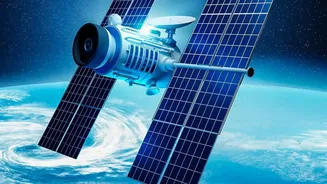
Satellites in Very Low-Earth Orbit (VLEO), typically flying below 400 kilometres, face a persistent problem: atmospheric drag. While the air is incredibly thin, it’s not a perfect vacuum. Residual particles of nitrogen and oxygen constantly push against
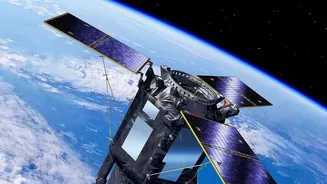
a satellite, slowing it down and causing its orbit to decay. To counteract this, satellites must fire thrusters, but this consumes precious onboard propellant like xenon. ESA's GOCE gravity-mapping satellite, for instance, operated at a low altitude but its mission ended once its 40kg of xenon fuel was depleted. This limitation not only dictates the lifespan of a mission but also contributes to the growing problem of space debris, as defunct satellites are left to tumble uncontrollably.
A New Kind of Engine for Space
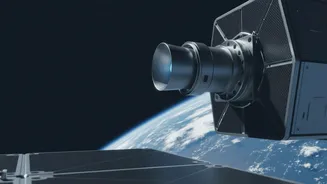
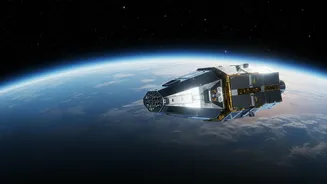
Air-Breathing Electric Propulsion (ABEP) systems offer an elegant solution: turn the problem into the propellant. Instead of carrying a finite supply of fuel, an ABEP-equipped satellite uses a specialised intake to scoop up the very atmospheric particles that cause drag. These collected molecules—mostly oxygen and nitrogen—are then channelled into an electric thruster. Inside the thruster, the particles are ionized (given an electric charge) and then accelerated by an electromagnetic field, creating a high-velocity exhaust that generates thrust. This thrust counteracts the atmospheric drag, allowing the satellite to maintain its orbit indefinitely without carrying any propellant. The concept, first proposed decades ago, is now on the cusp of becoming a reality thanks to advancements in electric propulsion and materials science.
The Promise of 'Unlimited' Missions
The implications of this technology are immense. Operating in VLEO offers significant advantages, including higher-resolution imagery for Earth observation, lower latency for communications, and reduced launch energy requirements. ABEP systems could unlock these benefits for long-duration missions. Imagine satellites providing persistent surveillance, uninterrupted internet service, or continuous climate monitoring for years on end, all powered by solar arrays and the thin atmosphere. This would dramatically lower the cost of satellite operations, as the need for frequent and expensive replacement launches diminishes. Furthermore, by ensuring satellites can maintain control, the technology promotes a more sustainable use of space, mitigating the creation of new debris.
From Theory to Reality
While the headline suggests full operation, the technology is more in an advanced testing and validation phase. In March 2026, a project division of TransMIT GmbH successfully completed a thruster design review with the European Space Agency (ESA), confirming the technical maturity of their cathodeless approach, a key step toward operational systems. Previous ground tests by ESA and its partners have successfully fired an ABEP thruster in a vacuum chamber simulating conditions at 200 km altitude, proving the core concept is feasible. However, challenges remain. The systems must be incredibly efficient to collect enough particles from the sparse environment. The corrosive nature of atomic oxygen at these altitudes also poses a threat to materials, especially critical components like cathodes in traditional electric thrusters. This has spurred innovation in cathodeless designs, like those being developed by TransMIT IQM and Phase Four, which received a significant DARPA contract to develop its own air-breathing system. These efforts are paving the way for the first true in-orbit demonstrations.