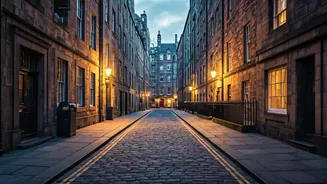









Begin on The Royal Mile
Your journey starts on The Royal Mile, the historic spine connecting Edinburgh Castle to the Palace of Holyroodhouse. This isn't one street but a succession of them, lined with towering tenement buildings that create a man-made canyon of dark, enduring
stone. Architecturally, it’s a masterclass in Scottish vernacular, a dense, vertical response to the city’s defensive walls. As you walk, look for the narrow alleyways, or “closes,” that branch off like fish bones. These are free to explore and offer the most authentic glimpse into Old Town life. This landscape was the daily reality for centuries of residents, including Deacon Brodie, the respectable cabinet maker by day and burglar by night whose double life inspired Robert Louis Stevenson's Dr. Jekyll and Mr. Hyde. The entire experience is free, fueled only by your imagination and a good pair of walking shoes.
Step Inside The Writers' Museum
Tucked away in Lady Stair's Close just off The Royal Mile, The Writers' Museum is an essential—and completely free—stop. Housed in a 17th-century building, the museum itself is an architectural treasure. Inside, it celebrates the lives of three giants of Scottish literature: Robert Burns, Sir Walter Scott, and Robert Louis Stevenson. You can see Burns’ writing desk, the printing press on which Scott’s Waverley Novels were produced, and a wardrobe from Stevenson’s childhood. It’s a quiet, intimate space that provides a powerful connection to the authors who walked these same streets. It’s the perfect budget-friendly way to ground your literary tour in tangible history before heading back out into the city they helped make famous.
Wander Through Greyfriars Kirkyard
A short walk from the Royal Mile, Greyfriars Kirkyard is more than just a cemetery; it's an atmospheric outdoor museum of art and history. The elaborate, often moss-covered headstones and mausoleums are stunning examples of funerary architecture from the 16th century onward. The Kirkyard is famously associated with Greyfriars Bobby, the loyal dog who guarded his master's grave. More recently, literary pilgrims flock here for its connection to the Harry Potter series. J.K. Rowling reportedly drew inspiration from the names on the headstones, including a certain Thomas Riddell. The moody, Gothic atmosphere of the graveyard, with Edinburgh Castle looming above, is profoundly cinematic and costs nothing to experience.
Find Magic on Victoria Street
From Greyfriars, wind your way down to Victoria Street, one of Edinburgh’s most photographed locations. With its gentle curve and brightly painted shopfronts, this 19th-century street is widely believed to be the inspiration for Diagon Alley. The two-level street is an architectural delight, with the lower level built into the steep gradient of the hillside. While shopping here can be expensive, the real joy is free: walking its cobblestones, admiring the colorful facades, and soaking in the whimsical atmosphere. Nearby is The Elephant House, the café that famously marketed itself as a writing spot for J.K. Rowling. While the cafe's future is uncertain after a fire, the street itself remains a testament to the magic of everyday architecture sparking literary genius.
Gaze Up at the Scott Monument
Dominating the skyline over Princes Street Gardens is the Scott Monument, a 200-foot-tall Victorian Gothic spire dedicated to Sir Walter Scott. It is the largest monument to a writer anywhere in the world. Its intricate, spiky design—often described as a “gothic rocket ship”—is blackened by centuries of pollution, giving it a dramatic, almost brooding presence. While you can pay a fee to climb the 287 steps for a panoramic city view, one of the best ways to appreciate its architectural ambition is from the ground. Sit in the gardens below and admire the sheer audacity of it, a testament to a time when a novelist was a national hero worthy of a cathedral-like memorial. It’s a powerful statement about the city’s relationship with literature.
Stroll Through the Georgian New Town
Finally, cross Princes Street and enter the New Town. This is a complete architectural counterpoint to the organic chaos of the Old Town. Planned in the 18th century, the New Town is a masterpiece of Georgian urban design, characterized by wide streets, grand squares, and elegant terraced houses with neoclassical details. This is the Edinburgh of reason and enlightenment. Robert Louis Stevenson grew up at 17 Heriot Row, a classic New Town address, and often wrote about the stark contrast between the respectable, orderly New Town and the dark, mysterious Old Town. Simply walking through streets like George Street or the residential areas around Queen Street Gardens gives you a feel for this other side of Edinburgh’s personality, another chapter in its architectural story that is, again, completely free to read with your feet.