


The Great European Eclipse of 2026
This celestial event will trace a path across the globe, beginning over the Arctic and Siberia before sweeping south. The main event, total darkness in the daytime, will occur over Greenland, western Iceland, and a swath of northern Spain, including cities
like Bilbao and Valencia. For those in these locations, the Sun will be completely obscured for up to two minutes. Meanwhile, a huge surrounding area, including most of Europe, northwestern Africa, and parts of eastern North America, will witness a partial eclipse, where the Moon takes a 'bite' out of the sun. While NASA will provide live coverage for all, the experience on the ground will be worlds apart depending on your location.
The Partial View: An Interesting Diversion
For the vast majority of viewers, the 2026 eclipse will be a partial one. This is a fascinating event in its own right. Through special-purpose solar filters or eclipse glasses, one can watch as the Moon slowly glides across the solar disk, turning the Sun into a fiery crescent. As more of the Sun is covered, the ambient light can take on a strange, steely quality, and shadows can become unusually sharp. If you look at the ground beneath a leafy tree, you might even see hundreds of tiny crescent suns projected on the pavement. However, at no point during a partial eclipse is it safe to look at the Sun without certified eye protection. Even when 99% of the Sun is covered, the remaining sliver is intensely bright and can cause permanent eye damage. It’s a cool astronomical event, but the sky remains bright and the world around you continues much as before.
Totality: An Otherworldly Experience
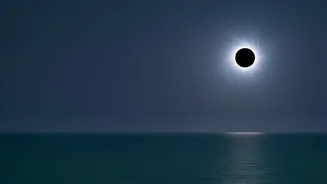
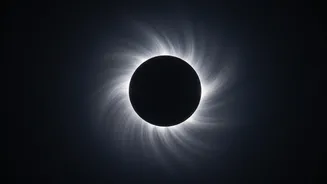
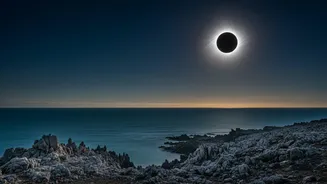
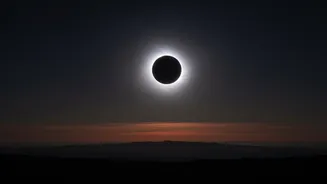
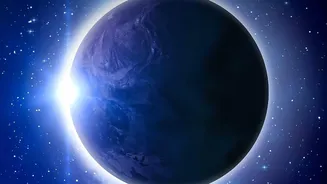
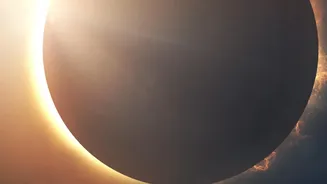
Experiencing a total solar eclipse is fundamentally different. It is not just a visual event; it's a fully immersive, multi-sensory phenomenon. As the final sliver of the Sun is about to be covered, the world changes dramatically. The temperature can drop noticeably. In the final seconds, brilliant points of light called Baily's Beads may flash as the last rays of sunlight stream through valleys on the Moon's rugged edge. This culminates in the 'diamond ring effect,' a single, dazzling point of light that shines out from the lunar silhouette. And then, suddenly, totality arrives. The sky plunges into a deep, disorienting twilight. Where the Sun once was, there is now a black hole in the sky, surrounded by the ethereal, wispy tendrils of the solar corona—the Sun's outer atmosphere, impossible to see at any other time.
The Magic You Only See in the Shadow
For the brief minute or two of totality, you can safely look upon this spectacle with the naked eye. Bright planets and stars, like Venus and Jupiter, may become visible in the midday sky. Looking toward the horizon reveals a bizarre 360-degree sunset, with bands of orange and pink light ringing the edge of the world under the Moon's shadow. The air grows still, and sometimes birds and insects, tricked into thinking night has fallen, will fall silent. It's a moment that has been described by seasoned eclipse chasers as life-altering, a profound connection to the cosmos that a 99% partial eclipse simply cannot deliver. A partial eclipse is watching an interesting event on a screen; a total eclipse is being inside the event itself.
Why 'Almost' Is Not Enough
The critical takeaway is that the difference between a 99% partial eclipse and a 100% total eclipse is not 1%. It’s the difference between day and night, between seeing a picture of a magnificent event and standing in the middle of it. All the most breathtaking phenomena—the corona, the diamond ring, the sudden darkness, the 360-degree sunset—only occur within the narrow path of totality. Cities like Madrid and Barcelona will see a deep partial eclipse of over 90%, but they will miss out on the true spectacle. For anyone with the means to travel, getting into that path is the only way to witness what makes a total solar eclipse one of nature’s most awe-inspiring events.