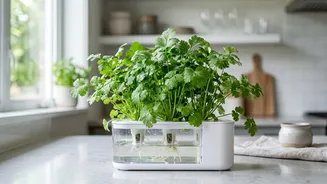






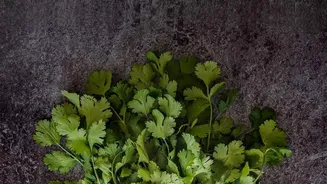
Craving fresh dhania for your curries and chutneys year-round? Growing coriander indoors is easier than you think with hydroponics, a soil-free method that delivers faster growth and robust flavour. Two popular systems stand out for home growers.
The Deep-Water Culture (DWC) Method
Deep-Water
Culture is often considered the simplest entry into hydroponics. In a DWC system, coriander plants sit in net pots with their roots suspended directly in a reservoir of nutrient-rich, oxygenated water. An air pump connected to an air stone constantly bubbles oxygen into the water, which is crucial for preventing root rot and ensuring the plant breathes. This setup is wonderfully straightforward and forgiving for beginners. It requires minimal moving parts—just a container, a lid, net pots, and an air pump. Because the roots are constantly submerged, there is a large buffer of water and nutrients, making the plants resilient to short-term neglect. For growing leafy greens and herbs like coriander, DWC is a cost-effective and reliable choice.
The Nutrient-Film Technique (NFT) Method
The Nutrient-Film Technique takes a different approach. Instead of submerging the roots, an NFT system uses a pump to create a continuous, shallow stream—or 'film'—of nutrient solution that flows down a sloped channel. The plants' bare roots hang into this film, absorbing water and nutrients while the upper parts of the roots are exposed to the air, providing excellent oxygenation. NFT is extremely water-efficient because the solution is recirculated from the channel back into a central reservoir. This method is also highly scalable and popular for vertical setups, allowing you to grow more coriander in a smaller footprint. However, it is more mechanically complex than DWC. A pump failure can be critical, as the thin film of water provides no reserve, and roots can dry out quickly.
Choosing Your System: DWC vs. NFT
So, which system is right for your indoor coriander garden? For beginners, DWC is generally the winner due to its simplicity and lower initial cost. It’s more forgiving if you’re just learning about nutrient management. NFT, on the other hand, is the champion of space efficiency. If you want to build a vertical garden to maximize your harvest, NFT channels are the ideal solution. In terms of performance, both systems will grow fantastic coriander. NFT might produce slightly faster growth due to the high oxygen levels at the root zone, but the difference for a home grower is often minimal. Your choice ultimately depends on your budget, available space, and how handson you want to be. DWC offers a simple, robust start, while NFT provides an efficient, space-saving path for those ready for a bit more complexity.
Keys to Success with Hydroponic Coriander
Regardless of whether you choose DWC or NFT, a few key conditions are vital for a successful harvest. Coriander is a cool weather herb and can 'bolt' (flower prematurely) if it gets too hot, which stops leaf production. Aim to keep the temperature between 18–22°C. The plant needs 12–16 hours of light per day, so a full–spectrum LED grow light is essential for indoor setups. You'll also need to manage the nutrient solution. Use a formula designed for leafy greens and maintain a pH level between 5.5 and 6.5 to ensure the plant can absorb all the food it needs. Finally, regularly check the electrical conductivity (EC) of your solution, a measure of nutrient strength, keeping it in the 1.2 to 1.8 range for optimal growth.