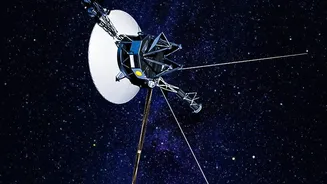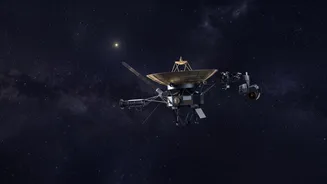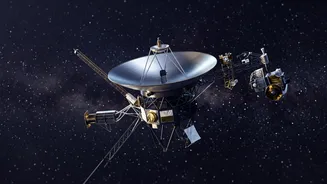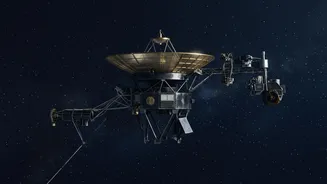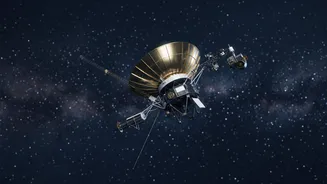




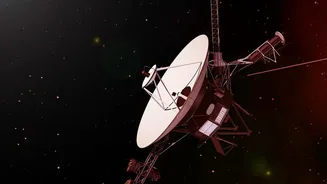
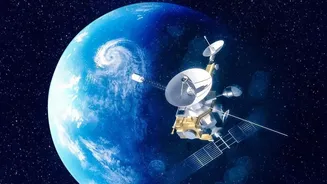
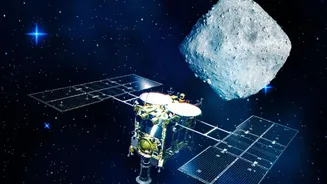
On November 18, 2026, a tiny ambassador from Earth will hit a milestone of cosmic proportions. Voyager 1 will be a full light-day away, forcing us to confront the mind-bending difference between how long it takes to travel and how we talk to it.
A Landmark in Deep Space
This month,
humanity’s farthest emissary, the Voyager 1 spacecraft, will achieve something unprecedented. On November 18, it is projected to be one light-day from Earth. This means the spacecraft will be so distant—roughly 25.9 billion kilometres—that a radio signal travelling at the speed of light will take a full 24 hours to reach it. For the first time, a human-made object will be so far away that our communications are delayed not by minutes, but by a day. This isn't a physical boundary Voyager will cross; it is a milestone defined entirely by the time it takes to have a conversation across the void.
Light-Distance vs. Actual Travel Time
The upcoming milestone perfectly illustrates a key concept: the vast difference between light-distance and travel time. Think of it like this: it took Voyager 1 nearly 50 years to travel the distance that light will cross in 24 hours. Launched on September 5, 1977, the probe has been journeying for decades at a staggering velocity of over 60,000 kilometres per hour. Yet, that speed is a crawl compared to the universal speed limit—the speed of light. Light travels at approximately 300,000 kilometres per second. So, while Voyager 1's travel time measures the duration of its physical journey since 1977, its light-distance measures how long it takes for a signal to cover the space between us right now.
A 49-Year Journey to a 1-Day Delay
Voyager 1's long road highlights this distinction. Its original mission was to explore Jupiter and Saturn, which it did with spectacular success in 1979 and 1980. It discovered volcanoes on Jupiter's moon Io and revealed the complexities of Saturn's rings. After its Saturn flyby, a gravitational slingshot sent it hurtling out of the plane of the solar system and toward interstellar space. It formally crossed into the space between stars in 2012. The 49 years it has taken to reach this point are a testament to 20th-century engineering. The fact that its signal, travelling at the fastest speed possible, will now take 24 hours to reach us is a testament to the sheer scale of the cosmos.
A Conversation on a Two_Day Lag
The practical implications are profound. When Voyager $^$ passes the light_day mark, the round_trip communication time will be $^$48 hours. Imagine mission controllers at NASA's Jet Propulsion Laboratory sending a command to the spacecraft. That signal, moving at the speed of light, will travel for $^$24 hours before it even arrives at Voyager $^$! After the spacecraft executes the command and sends back a confirmation or data, that return signal will take another $^$24 hours to get back to Earth. Engineers sending a query on a Monday would not receive a reply until Wednesday. This reality underscores the immense challenges of operating a probe in interstellar space, where every interaction is subject to an ever_growing, physics_imposed delay.
A Silent Ambassador for Millennia
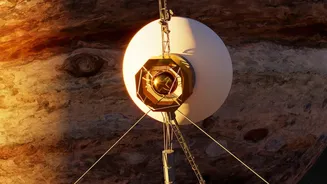
Despite its age and dwindling power from its plutonium source, Voyager $^$ continues to send back invaluable data from a region no other probe has ever visited. Engineers have had to get creative, recently performing delicate operations to conserve power and keep its scientific instruments from freezing. Even after its instruments are projected to go silent sometime in the $^$2030s, its journey will be far from over. It is heading in the general direction of a star named Gliese $^$445, which it will pass in about $^$40,000 years. Long after its signal fades, Voyager $^$! and its twin, Voyager $^$! will continue as silent ambassadors, carrying their Golden Records—time capsules of Earth's sights and sounds—on a near_eternal voyage through the Milky Way.