


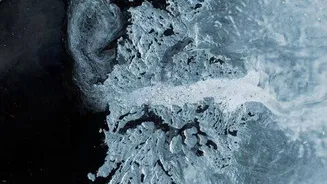
The Planet’s Frozen Archives
In the vast, frozen expanses of Greenland and Antarctica, researchers drill deep into ice sheets to extract cylinders of ice called cores. These cores are like time capsules, offering a remarkably detailed history of Earth’s climate. As snow falls and accumulates
over millennia, it compacts into layers, trapping tiny bubbles of the ancient atmosphere. By analyzing these air bubbles, scientists can directly measure the concentration of greenhouse gases like carbon dioxide and methane from as far back as 800,000 years ago. Furthermore, the chemical composition of the water molecules in the ice, specifically the ratio of different oxygen isotopes, acts as a thermometer, revealing the temperature when the snow first fell. This frozen library has shown that past periods of warming and cooling were tightly linked to greenhouse gas levels and that today's CO2 concentrations are unprecedented in recent geological history.
Stories Told by the Ocean Floor
The bottom of the ocean is a vast repository of climate history, collected layer by layer over millions of years. Scientists use massive drills on research ships to extract long sediment cores from the seafloor. These cores contain the fossilized shells of tiny marine organisms called foraminifera. These creatures build their shells from calcium carbonate, and the chemical makeup of the shells reflects the temperature and chemistry of the water they lived in. By analyzing the oxygen isotopes in these ancient shells, researchers can reconstruct past ocean temperatures and global ice volume, charting the planet's glacial and interglacial cycles. Dust and volcanic ash carried by wind and rivers also settle on the seafloor, and their presence in sediment cores can reveal ancient wind patterns and major geological events.
Whispers from Ancient Caves
Deep inside caves, another powerful climate proxy is at work: speleothems. These are mineral deposits, better known as stalactites and stalagmites, that form over thousands of years from dripping groundwater. As water seeps through the ground, it picks up chemical signatures from the environment. When this water drips into a cave and deposits minerals, those signatures become locked in the layers of the growing speleothem. Similar to ice cores, the oxygen isotopes in these formations can reveal information about past temperatures and rainfall patterns. Scientists can date these layers with incredible precision, providing high-resolution records of regional climate shifts, such as changes in monsoon intensity or periods of prolonged drought. These cave records have been instrumental in understanding rapid climate changes of the past.
The Earth's Wooden Diaries
Closer to the surface, trees serve as living records of climate variability. The science of dendrochronology, or tree-ring dating, examines the annual growth rings of trees. In a good growing year with favorable temperatures and ample moisture, a tree will produce a wide ring. In a year of drought or extreme cold, the ring will be narrow. By taking small, harmless core samples from very old trees, scientists can piece together a timeline of local climate conditions stretching back hundreds or even thousands of years. These records are especially valuable for reconstructing regional patterns of temperature and precipitation, providing context for events like historic droughts and how different ecosystems have responded to climate stress over time.