




Turning Martian Air into Breathable Oxygen
Making Mars habitable is one of the greatest technical challenges humanity has ever faced. A crucial piece of that puzzle is In-Situ Resource Utilization (ISRU), a strategy focused on using local resources to survive. On Mars, the most abundant resource is the atmosphere
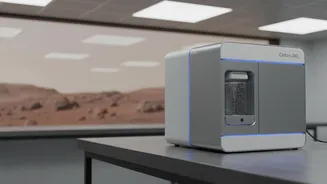
itself, which is composed of about 96% carbon dioxide (CO2). Scientists have long focused on a process called solid oxide electrolysis (SOE) to crack this CO2. In simple terms, the technology works like a high-tech filter. It pulls in the thin Martian air, heats it to around 800°C, and then uses an electrochemical process to split the carbon dioxide molecules into breathable oxygen (O2) and carbon monoxide (CO). The concept was famously proven by NASA's MOXIE (Mars Oxygen In-Situ Resource Utilization Experiment) instrument aboard the Perseverance rover, which successfully produced oxygen on Mars multiple times, validating the core technology. MOXIE produced about 122 grams of oxygen in total during its mission, proving that creating air from the Martian atmosphere is not just science fiction.
The Challenge of Efficiency and Durability
While MOXIE was a groundbreaking success, it was a small-scale technology demonstration. Scaling it up to produce the metric tons of oxygen needed for a human mission presents major hurdles. Astronauts need oxygen for life support, but even larger quantities are required to create rocket propellant for the return journey to Earth. One of the primary challenges with the current solid oxide electrolysis (SOE) technology is degradation. The high temperatures and direct exposure to carbon dioxide can cause oxidation on parts of the electrolysis cells, specifically the cathode, which shortens their lifespan and reduces the oxygen production rate. To get around this, the MOXIE system had to use a complex process involving recycling some of the carbon monoxide byproduct to protect the hardware. This adds complexity, mass, and potential points of failure to a system that needs to be incredibly reliable and autonomous for years.
New Materials and Methods for Optimization
This is where the latest optimizations come in. Planetary scientists and engineers are now developing novel materials and alternative methods to make oxygen production more efficient and robust. One promising avenue of research involves creating new cathode materials that are inherently resistant to oxidation. By using advanced materials like perovskites, scientists aim to build electrolysis cells that can operate directly in the Martian atmosphere without the need for the complex CO recycling system, which could reduce the overall system mass by up to 3% and significantly increase reliability. Other researchers are exploring entirely different approaches, such as using low-temperature plasmas instead of high-temperature electrolysis. Plasma-based systems could potentially decompose CO2 with higher energy efficiency and at a much faster rate. Some studies suggest plasma reactors could produce oxygen over 30 times faster than the rate demonstrated by MOXIE, a massive leap in productivity.
More Than Just Breathing: Fuel for the Trip Home
The ability to generate oxygen on Mars is a game-changer for two critical reasons. The first is obvious: providing breathable air for astronauts in their habitats and spacesuits. The second is arguably even more important for the long-term economics of space travel: producing rocket propellant. A typical Mars Ascent Vehicle (MAV) requires a massive amount of oxidizer (oxygen) to burn its fuel for liftoff. In fact, oxygen makes up about 78% of the required propellant mass. Transporting all that oxygen from Earth is prohibitively expensive; it's estimated that for every ton of payload landed on Mars, 12 to 13 tons need to be launched into Earth's orbit first. By manufacturing the oxygen on-site, a Mars mission could launch from Earth carrying only the fuel (like methane), dramatically reducing launch mass and cost. This makes the entire architecture of a human mission to Mars more sustainable and affordable.