




The Age-Old Question
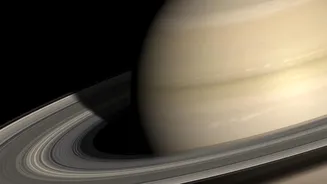
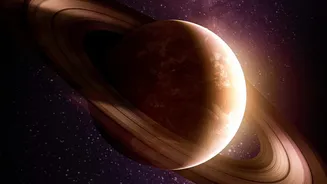
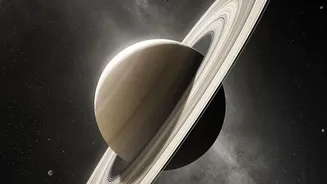
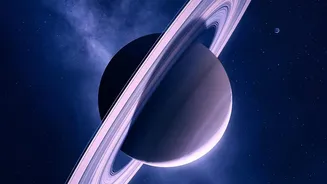
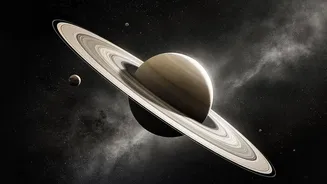
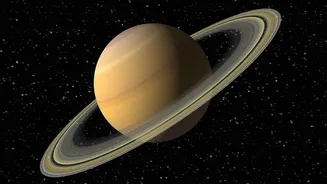
The central mystery of Saturn's rings has always been their age. Are they ancient relics, formed alongside the planet itself some 4.5 billion years ago? Or are they a relatively recent addition to the solar system? For decades, scientists have been divided.
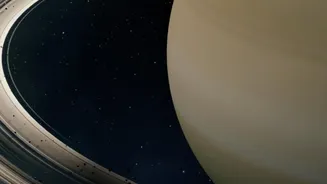
The breathtaking brightness of the rings, which are composed of about 98% pure water ice, suggested they must be young. Over billions of years, the constant bombardment of dark micrometeoroids should have polluted and darkened them, much like pristine snow on a roadside becomes dirty over a long winter. This observation formed the basis of the 'young rings' theory, but definitive proof remained elusive.
Cassini's Grand Finale
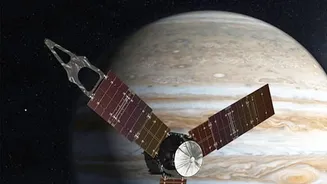
NASA's Cassini spacecraft, which orbited Saturn from 2004 to 2017, was designed to solve this puzzle. In its final, daring act, the 'Grand Finale,' Cassini made 22 dives between the planet and its rings. These manoeuvres allowed scientists to do something remarkable: essentially weigh the rings by measuring their gravitational pull on the spacecraft. A lower mass would imply younger, more transient rings. At the same time, Cassini's Cosmic Dust Analyzer meticulously counted the incoming micrometeoroid particles, providing a crucial estimate of the pollution rate. By combining the ring's mass with the rate at which they are being contaminated, scientists hoped to calculate a definitive age.
Younger Than The Dinosaurs
The initial analysis of Cassini's data strongly supported the theory that the rings are astonishingly young. Studies released in recent years pegged their age at no more than 400 million years, and perhaps as young as 10 to 100 million years old. This means the rings may have formed when dinosaurs still roamed the Earth and were not a feature of the early solar system. One leading theory suggests the rings are the shattered remains of a former icy moon, nicknamed 'Chrysalis,' that strayed too close to Saturn and was ripped apart by the planet's immense gravity. Simulations have shown that such an event could create a ring system with the exact mass and pristine icy composition we see today.
A Challenge to the New Consensus
Just as the scientific community began to lean towards the 'young rings' hypothesis, contradictory findings emerged. Some researchers argue that the rings might be as old as Saturn itself, but have a self-cleaning mechanism that makes them appear deceptively young. One recent study using computer modelling suggests that when micrometeoroids strike the icy ring particles, they don't just add dark dust; they vaporize. The resulting charged particles are then either drawn into Saturn or ejected from the system, effectively keeping the rings spotless over billions of years. This new model challenges the core assumption that the rings' brightness is a reliable indicator of their age, reopening the debate entirely.
The Mystery of 'Ring Rain'
Adding another layer of complexity is the phenomenon of 'ring rain.' Data from Cassini showed that the rings are not stable; they are constantly losing material that falls into Saturn's atmosphere. This icy downpour is happening at an astonishing rate of thousands of kilograms per second. Based on this rate of loss, some calculations suggest the rings could disappear entirely in another 100 to 300 million years. However, the composition of this rain is also perplexing. It is not just water, but a surprising cocktail of complex organic molecules. Understanding where these molecules come from and how the rate of rain changes over time is now critical to piecing together the rings' past and future.