



A Personal Bubble of Life
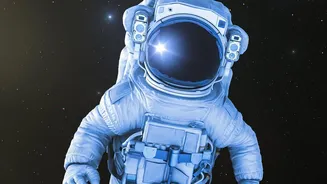
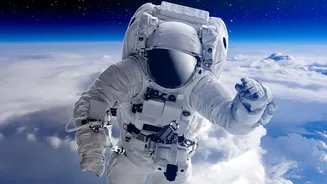
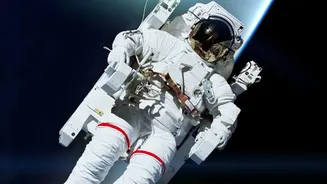
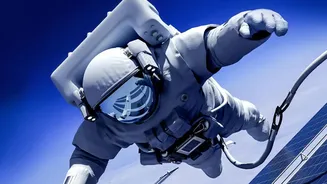
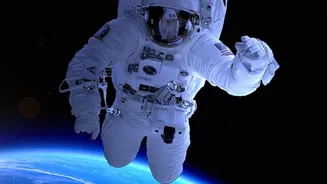
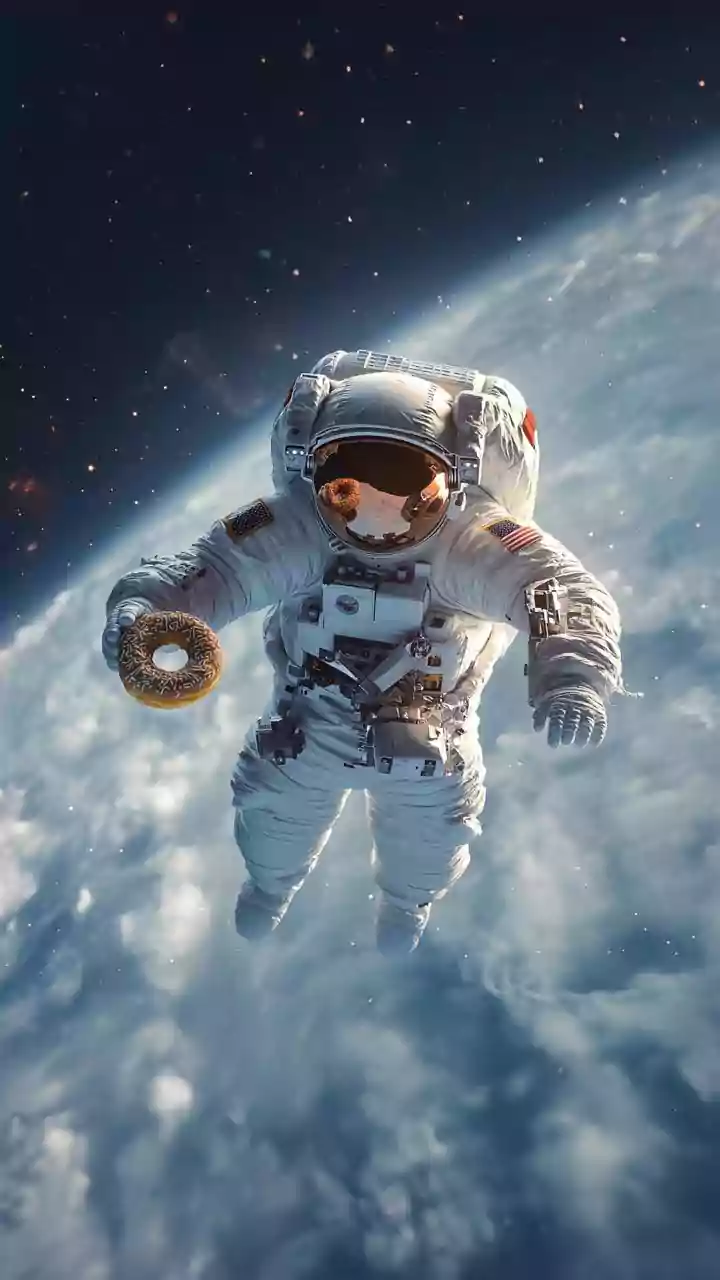
The most immediate danger in space is the vacuum. Without the Earth's atmosphere, there is no air to breathe and no pressure. If exposed, a human would lose consciousness in seconds. A spacesuit, known formally as an Extravehicular Mobility Unit (EMU),
is fundamentally a personal spacecraft. It creates a bubble of life-sustaining pressure and provides pure oxygen for the astronaut to breathe. The suit itself consists of multiple layers. An inner, urethane-coated nylon layer acts as a pressure bladder, holding the air in. A restraint layer of Dacron is wrapped around this bladder to prevent it from ballooning and to maintain the suit’s shape, allowing the astronaut to move. A complex backpack, the Primary Life Support System, provides the oxygen, removes the carbon dioxide the astronaut exhales, and powers the entire suit.
Surviving the Fiery Cold
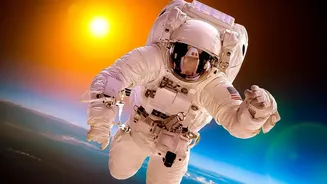
Space has no stable temperature. In direct sunlight, surfaces can heat up to 120 degrees Celsius, while in shadow they can plunge to minus 150 degrees Celsius. To protect against these extremes, spacesuits are layered like a sophisticated thermos. Several layers of aluminised Mylar, separated by fabric spacers, create a vacuum insulation that drastically slows heat transfer. But the real key to comfort is the Liquid Cooling and Ventilation Garment (LCVG). This is a full-body undergarment made of spandex, threaded with hundreds of feet of thin plastic tubes. Chilled water circulates through these tubes, absorbing the astronaut's body heat from strenuous work and carrying it to a device on the backpack called a sublimator. This device exposes the heated water to the vacuum of space, where it freezes and then turns directly into vapour, carrying the excess heat away with it.
A Shield Against Invisible Dangers
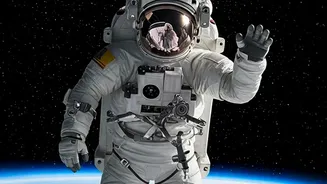
Beyond the vacuum and temperature, space is filled with invisible threats, most notably radiation. Outside the protection of Earth's magnetic field, astronauts are exposed to high-energy cosmic rays and particles from the sun. While a spacesuit cannot block all of this radiation, its layers offer significant protection against lower-energy particles and UV radiation. The outermost layers of the suit and the helmet's visor are designed to reflect as much radiation as possible. The helmet's extravehicular visor has a special, micro-thin coating of gold that is transparent enough to see through but effective at reflecting harmful ultraviolet and infrared rays, protecting the astronaut's vision and skin.
Armour for Space Dust
Even a grain of sand can be deadly in orbit. Micrometeoroids and tiny pieces of man-made debris travel at incredible speeds, many times faster than a bullet. A direct impact from one of these could easily puncture a normal garment, causing a catastrophic depressurisation. To combat this, the outer layers of a spacesuit form a Thermal Micrometeoroid Garment. This is a multi-layered shield composed of tough, impact-resistant fabrics like Kevlar and Nomex. When a particle strikes the suit, these outer layers are designed to shatter it into smaller, less harmful fragments, dispersing its energy before it can reach the critical pressure bladder deep inside the suit. The white colour of this outer layer also helps by reflecting the intense solar radiation.