



The Sweet Showdown in Every Kitchen
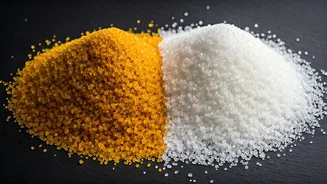
The two ingredients in question are, of course, jaggery (gur) and refined white sugar. For generations, they have been the two dominant forces of sweetness in Indian households. One is a golden-to-dark-brown, unrefined block of tradition, carrying with
it the fragrant history of ancient wellness practices and festive cooking. The other is a sparkling white, uniform crystal, a symbol of industrial precision and culinary neutrality. The popular narrative frames them as direct competitors. We are often told to pick a side, to declare one the winner in the quest for a healthier, tastier life. But this head-to-head comparison, while common, oversimplifies their roles and ignores their unique strengths.
From Ancient Roots to Modern Refinement
To understand why they aren’t true rivals, we need to look at their origins. Jaggery has been a staple in the subcontinent for centuries, an integral part of not just cuisine but also Ayurvedic medicine. Made by boiling sugarcane juice or palm sap with minimal processing, it’s a product deeply intertwined with rural economies and cultural rituals, used in offerings during festivals like Pongal and Makar Sankranti. Refined sugar, on the other hand, is a product of the industrial age. It’s made by taking sugarcane juice through an extensive refining process that strips away everything but pure sucrose. This process creates a consistent, neutral sweetener, but one that is disconnected from its agricultural origins and devoid of the minerals that jaggery retains.
The Nutritional Nuance
The health debate is where the rivalry seems fiercest. Jaggery is often touted as the healthier choice because it is unrefined and contains trace amounts of minerals like iron, magnesium, and potassium, which are absent in white sugar. While this is true, it's crucial to look at the bigger picture. Both jaggery and sugar are, calorically, almost identical. Both are primarily sucrose and will raise your blood sugar. In fact, surprisingly to many, most common sugarcane jaggery has a higher Glycemic Index (GI) of around 84, compared to white sugar's GI of 65, meaning it can spike blood sugar even faster. So, while jaggery offers a tiny nutritional bonus, it is not a 'health food' to be consumed without limit. Moderation is key for both.
A Tale of Two Flavours
This is where the argument for co-existence becomes strongest. Jaggery and sugar serve fundamentally different culinary purposes because they taste completely different. Refined sugar is a one-note performer: it delivers pure, clean sweetness without any other flavour. This makes it perfect for delicate desserts, baking where precise chemical reactions are needed, or sweetening a cup of tea without altering its taste. Jaggery, conversely, is a complex character actor. It brings a rich, caramel or molasses-like flavour, an earthy depth, and a distinct aroma to any dish. It’s the soul of traditional sweets like 'til gud' or 'modak' and adds a balancing warmth to savoury dishes like dals and chutneys. You wouldn't use jaggery in a light lemon tart for the same reason you wouldn't use white sugar to get the deep, nuanced flavour of a traditional 'gur ki chai'.
Specialists, Not Competitors
Thinking of jaggery and sugar as rivals is like pitting a violin against a drum. Both are essential parts of the orchestra, but you would never ask one to do the other's job. Jaggery is a flavour ingredient that also happens to be sweet. Sugar is a sweetening agent that is designed to be neutral. One provides character, complexity, and a touch of nutrition; the other provides clean sweetness, consistency, and structural integrity in baking. They aren't interchangeable because their functions are distinct. A modern Indian kitchen has a place, and a need, for both.