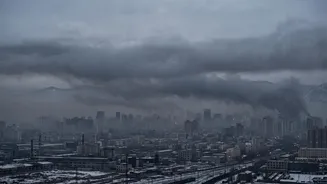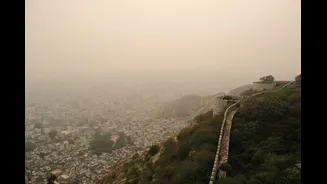






Ever wonder why the sky over many Indian cities turns into a thick, grey blanket, especially during winter? The culprit is often an invisible meteorological event known as an atmospheric inversion, which acts like a lid on the sky.
How The Atmosphere Should Work
On a typical day, the
sun warms the Earth's surface. This, in turn, warms the layer of air closest to the ground. Warm air is lighter and less dense, so it rises. As it ascends into the upper atmosphere, it cools, disperses, and carries pollutants away with it. This constant vertical mixing is the atmosphere's natural cleaning mechanism. Cooler, denser air from above sinks to take its place, gets warmed by the surface, and rises again. This continuous cycle, known as convection, is crucial for maintaining air quality by preventing pollutants from lingering at breathing level.
The Inversion: When The Lid Closes
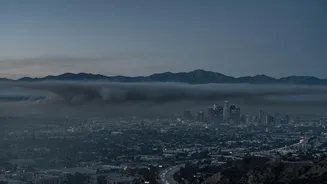
An atmospheric inversion, also called a temperature inversion, flips this normal process on its head. It occurs when a layer of warmer air settles above a layer of cooler air near the ground. This warm air acts like an invisible 'lid' or 'cap' on the atmosphere, stopping the cooler, denser air below from rising. Because the air near the surface is now colder and heavier than the air above it, the natural vertical mixing process comes to a halt. The air becomes stagnant, and anything within that trapped layer of cool air is stuck.
The Making of a Pollution Trap
Inversions are a natural phenomenon, often forming on calm, clear nights. As the sun sets, the ground rapidly loses heat, cooling the air closest to it. The air higher up, however, remains warmer. This is particularly common during North India's winters, characterized by longer nights, less direct sunlight, and calm winds. When these conditions align, a strong inversion can form and persist for hours, sometimes even into the next day if the sun isn't strong enough to warm the ground and break the cycle. Geographical features, like the Indo-Gangetic Plain being land-locked by the Himalayas, can further trap this stable air mass.
Concentrating Ground-Level Pollutants
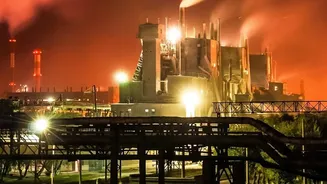
This atmospheric lid becomes a serious problem in areas with high pollution. Emissions from vehicles, industrial activity, construction dust, and seasonal stubble burning get released into the trapped layer of cool air. Unable to disperse upwards, these pollutants—including harmful particulate matter (PM2.5) and nitrogen oxides—accumulate, leading to a rapid and dangerous spike in ground-level concentrations. The mixing height, which is the altitude pollutants can normally disperse up to, can shrink from over a kilometre in summer to just a few hundred metres during a winter inversion, concentrating the same amount of pollution in a much smaller volume of air. This is why air quality can deteriorate dramatically overnight and peak in the early morning hours.
Smog and Secondary Pollutants
The trapped pollutants can also undergo chemical reactions. In the presence of sunlight, nitrogen oxides and volatile organic compounds (VOCs) react to form ground_level ozone, a major component of smog. While the ozone layer in the upper atmosphere is protective, ground_level ozone is a harmful pollutant that can cause respiratory problems. The combination of fog, which often forms in the cool, moist air during an inversion, and pollutants like smoke and ozone creates the thick, toxic smog that plagues many cities. This hazardous mix reduces visibility and poses significant health risks.
Breaking the Inversion
Fortunately,' inversions do not last forever.' They can be broken in a couple of ways.' The most common is through solar heating.' As the sun rises and warms the ground,' the layer of air near the surface heats up,' eventually becoming warmer and lighter than 'the 'lid'' above it.' This restores 'the normal convection cycle,' allowing 'the trapped pollutants to finally rise and disperse.' Alternatively,' the arrival of 'a strong weather system with brisk winds can physically blow 'the stagnant air mass away,' mixing 'the layers and clearing 'the air.' Until then,' however,' pollution levels will remain dangerously high.