


A New Vantage Point in the Cosmos
Roman is journeying to a spot nearly 1.5 million kilometres from Earth, known as the second Sun-Earth Lagrange point, or L2. This is a special location where the gravitational pulls of the Sun and Earth balance out, allowing the spacecraft to maintain
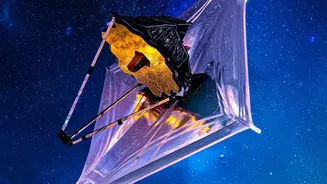
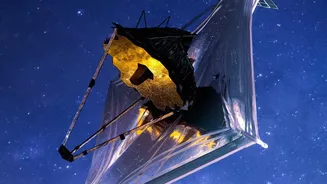
a stable position with minimal fuel. It’s a popular neighbourhood for powerful observatories, as the James Webb Space Telescope (JWST) also operates here. After about three months of travel and commissioning, Roman will begin its five-year primary mission. From this distant outpost, with its sunshade deployed, the telescope can conduct long, uninterrupted observations of the universe, shielded from the heat and light of the Sun, Earth, and Moon.
Hunting the Mysteries of Dark Energy
One of Roman’s primary jobs is to tackle one of the biggest puzzles in modern physics: dark energy. This mysterious force is believed to be responsible for the accelerating expansion of our universe, yet scientists know very little about it. Roman will investigate dark energy using three distinct methods. It will hunt for thousands of distant exploding stars, called Type Ia supernovae, and use their predictable brightness to measure cosmic distances and expansion rates. It will also map the 3D distribution of billions of galaxies to study how their clustering has changed over cosmic history. Finally, it will use a technique called weak gravitational lensing, measuring how the light from distant galaxies is subtly distorted by the gravity of unseen dark matter, which will help trace the universe's expansion.
A Grand Census of Alien Worlds
While missions like Kepler were revolutionary, they were best at finding large planets orbiting very close to their stars. Roman is designed to conduct a massive census of exoplanets using a different and powerful technique called gravitational microlensing. This effect occurs when a star with a planet passes in front of a more distant star. The gravity of the foreground star and its planet acts like a natural lens, briefly magnifying the light of the background star. This method is sensitive enough to find planets far from their host stars, in orbits similar to those in our own solar system, and can even detect rogue planets that drift through space without a parent star. It's expected that Roman will discover thousands of new planets this way, providing a more complete picture of planetary systems in our galaxy.
A Panoramic View Like Never Before
The key to Roman’s power is its Wide-Field Instrument, a 300-megapixel camera that gives it a colossal field of view. Each image Roman takes will have the same sharpness and quality as one from the Hubble Space Telescope but will cover an area of the sky 100 times larger. To put that in perspective, Roman will be able to map the sky between 100 to 1,500 times faster than Hubble ever could. This makes Roman a survey machine, built to create vast, panoramic maps of the cosmos. While Webb and Hubble act like zoom lenses, focusing on specific targets for detailed study, Roman is the wide-angle lens, providing the crucial context of where those objects fit into the grand cosmic tapestry.
Testing Tech for Future Discoveries
Beyond its primary surveys, Roman carries a technology demonstration called the Coronagraph Instrument. A coronagraph is designed to block the overwhelming glare from a bright star, allowing astronomers to directly image the much fainter planets orbiting it. Roman's coronagraph is about 100 times more powerful than previous instruments, capable of detecting planets a billion times dimmer than their host star. While primarily a testbed, this instrument will pave the way for future missions specifically designed to find and characterize Earth-like planets around other stars, such as the planned Habitable Worlds Observatory.