



The Oldest Star Collections
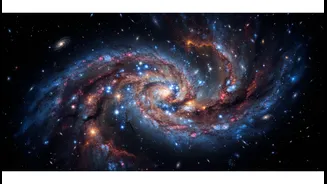
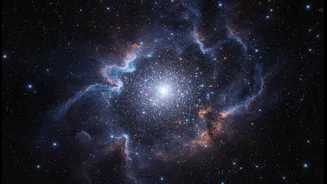
Dotted around the edges of our Milky Way and other galaxies are ancient, spherical collections of stars called globular clusters. These are some of the oldest objects in the universe, each one a dense, glittering ball containing hundreds of thousands,
or even millions, of stars packed tightly together by gravity. For a long time, their origin has been a cosmic puzzle. Astronomers have long viewed them as cosmic fossils, containing stars that are almost as old as the universe itself, offering a unique window into the conditions of the early cosmos just a few hundred million years after the Big Bang.
A Complicated Family Tree
The long-held theory was that the stars in a globular cluster all formed together in a single burst from the same giant cloud of gas. This would mean they should all have the same age and chemical composition. However, as telescopes like Hubble have peered into them with greater detail, a more complex picture has emerged. Many of these clusters contain multiple generations of stars, with different chemical makeups. This surprising discovery forced a rethink. Some astronomers proposed that these clusters might be the leftover cores of small dwarf galaxies that were long ago swallowed by larger ones like our own Milky Way.
Seeing Back in Time
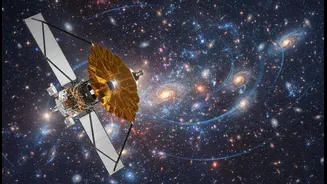
The headline's claim hinges on observations from space telescopes like Hubble and the James Webb Space Telescope (JWST), which act as powerful time machines. Because light takes time to travel across vast distances, when we look at faraway objects, we are seeing them as they were in the distant past. Recent studies combining data from both telescopes have examined thousands of young star clusters in nearby galaxies. By analyzing clusters at different stages of their evolution, from still being shrouded in their birth clouds to fully emerged, scientists can build a timeline of how they form and grow.
What 'Instantly' Really Means
Here's where we get to the idea of 'instant' formation. The headline is dramatic, but in cosmic terms, 'instant' doesn't mean snapping your fingers. Recent findings suggest that the most massive star clusters — the modern-day equivalents of those ancient globular clusters — clear out their natal clouds of gas and dust incredibly quickly. While a smaller cluster might take 7 to 8 million years to emerge, the most massive ones can do it in just 5 million years. This rapid emergence, driven by the intense radiation and stellar winds from massive young stars, is what scientists mean by a faster formation process. These clusters go from hidden nurseries to brilliant stellar cities in a cosmological blink of an eye.
The Role of Galactic 'Seeds'
The concept of 'ancient galactic seeds' refers to the initial conditions required for such rapid and massive star formation. This could mean several things. One idea is that the direct collapse of truly massive, pristine gas clouds in the early universe could form a supermassive star, which then seeds a dense cluster around it. Another theory focuses on the idea that the first stars (known as Population III stars) were extremely massive and short-lived, exploding and seeding their environment with the first heavy elements, which then influenced how the next generation of stars formed into clusters. These 'seeds' created the dense environments necessary to kickstart the formation of the stellar groupings we see today as globular clusters.